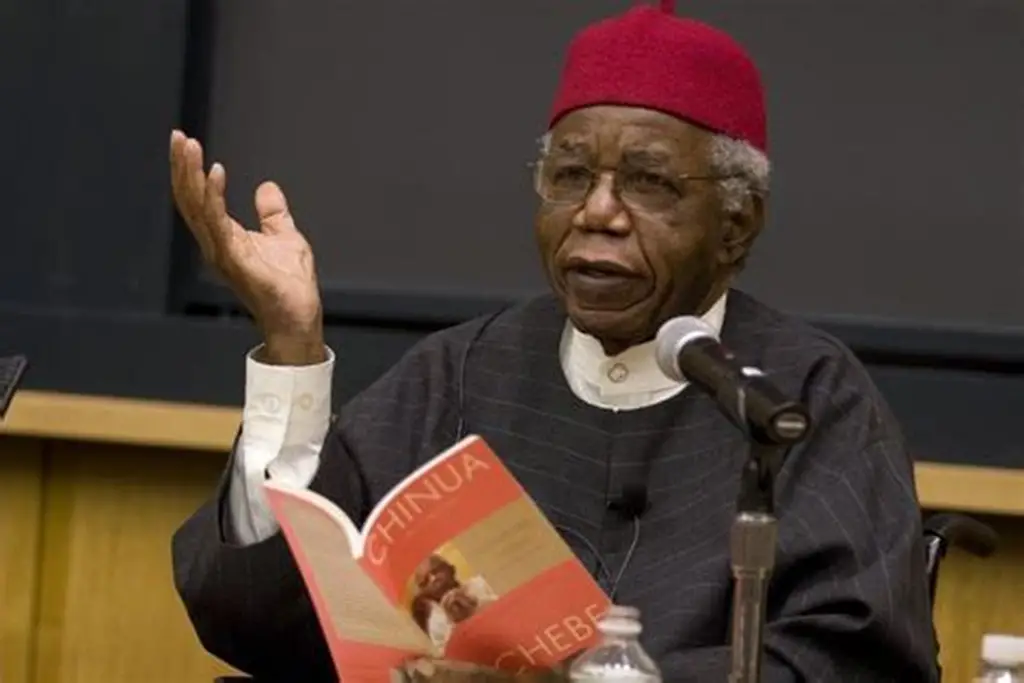
Chinua Achebe, born Albert Chinụalụmọgụ Achebe, was a Nigerian novelist, poet, professor, and literary critic widely regarded as the father of modern African literature. Renowned for his groundbreaking novel Things Fall Apart, Achebe transformed global perceptions of African history, culture, and identity through powerful storytelling and thought-provoking works.
Born on November 16, 1930, in Ogidi, Anambra State, he became one of the most influential writers of the twentieth century, inspiring generations of authors and scholars worldwide. His remarkable contributions to literature, education, and postcolonial thought earned him international acclaim and numerous prestigious honors before his passing on March 21, 2013. This article explores Chinua Achebe’s biography, literary career, major works, achievements, personal life, and enduring legacy.
His works captured the complexities of Igbo life, the impacts of colonialism, and the challenges of post-independence Africa with clarity and depth. Achebe wrote in English but infused his stories with Igbo proverbs, oral traditions, and cultural nuances, creating narratives that resonated globally while staying rooted in African experiences. His debut novel, Things Fall Apart, published in 1958, became one of the most influential books in African literature, translated into numerous languages and studied worldwide.
Chinua Achebe Early Life
Chinua Achebe was born on November 16, 1930, in Ogidi, an Igbo town in the eastern part of Colonial Nigeria, specifically in what is today Anambra State. His full birth name was Albert Chinụalụmọgụ Achebe. He was the fifth of six surviving children born to Isaiah Okafo Achebe and Janet Anaenechi Iloegbunam Achebe.
His parents belonged to the Igbo ethnic group, one of Nigeria’s major ethnic communities concentrated in the southeast. Ogidi, his hometown, had a rich history as an early center of Anglican missionary activity in Igboland. Isaiah Achebe worked as a teacher and evangelist for the Church Missionary Society. He was among the first converts to Christianity in the region but maintained respect for certain traditional Igbo practices, influenced by family elders. Janet Achebe, daughter of a blacksmith, was active in church women’s groups and engaged in farming.
The Achebe family lived at the intersection of traditional Igbo culture and colonial Christian influences. Storytelling formed a core part of young Chinua’s upbringing. His mother and sister Zinobia shared many Igbo folktales with him, which he loved to hear repeatedly. These early exposures to oral traditions later shaped his writing style, rich in proverbs and communal narratives. The family home featured religious images and books, including adaptations of Shakespeare and an Igbo version of The Pilgrim’s Progress, exposing him to both Western and local literary forms.
Achebe grew up during British colonial rule, when Nigeria was administered as a colony. Educated Igbo families like his held relatively privileged positions, yet they navigated tensions between indigenous customs and imposed Western ways. He witnessed masquerade ceremonies and village events that celebrated Igbo heritage, experiences he would later recreate vividly in his fiction.
In 1936, Achebe started primary education at St. Philips’ Central School in Ogidi. He showed early academic promise and advanced quickly. Teachers noted his excellent handwriting and reading skills. He briefly attended a religious class for younger children but was moved up due to his abilities. His education continued at other schools, including Nekede Central School near Owerri.
Chinua Achebe State of Origin and Cultural Roots
Chinua Achebe hailed from Anambra State in southeastern Nigeria. Ogidi, his specific community, is part of the Igbo heartland, known for its entrepreneurial spirit, rich artistic traditions, and strong emphasis on education and achievement. The Igbo people have a decentralized social structure with village democracies, age-grade systems, and title-taking societies that value personal accomplishment alongside community welfare.
Anambra State, one of Nigeria’s 36 states, lies in the South East geopolitical zone. It borders states like Enugu, Imo, and Kogi, with the River Niger influencing its geography and economy. Historically, the area saw significant missionary activity, leading to high literacy rates early on. Ogidi itself was a hub where traditional governance coexisted with Christian missions. Achebe’s works often drew directly from this environment, portraying the dignity and complexities of Igbo society before and during colonial disruption. His deep connection to Igbo language, proverbs, and cosmology allowed him to counter simplistic colonial portrayals of Africa.
This cultural grounding remained central throughout his life. Even as he engaged with global ideas, Achebe championed African perspectives and critiqued narratives that diminished African agency and history.
Chinua Achebe Education
Achebe’s formal education reflected both colonial structures and his personal drive. After primary school, he attended the prestigious Government College Umuahia in present-day Abia State. This institution, modeled on British public schools, provided rigorous training and exposed students to Western classics while fostering discipline.
In 1948, he joined the first intake at University College Ibadan (now University of Ibadan), affiliated with the University of London. He initially studied medicine on a scholarship but switched to English, history, and theology after developing strong criticisms of Western literature’s depictions of Africa. The switch cost him his initial scholarship, but family support and a government bursary enabled him to continue.
At university, Achebe contributed to campus magazines like the University Herald, serving as editor and publishing essays and short stories. Works such as “In a Village Church” and “Dead Men’s Path” explored themes of tradition versus modernity. He read widely, from European authors to emerging African voices, and grew increasingly aware of biased portrayals in books like Joyce Cary’s Mister Johnson. This realization fueled his commitment to authentic African storytelling.
He graduated in 1953 with a second-class degree, a result that initially disappointed him but did not deter his path.
Chinua Achebe Career
Achebe’s professional journey spanned broadcasting, teaching, writing, and academia. It was marked by a dedication to literature that elevated African voices on the world stage.
Chinua Achebe Early Career in Broadcasting and Teaching
After graduation, Achebe taught briefly at the Merchants of Light School in Oba. The school had limited resources, but he encouraged students to read widely. In 1954, he moved to Lagos and joined the Nigerian Broadcasting Service (NBS). There, he worked in the Talks Department, crafting scripts that honed his skills in dialogue and oral delivery. This experience proved valuable for his later fiction.
His time in Lagos exposed him to the vibrant, multicultural energy of a growing city filled with migrants from rural areas. He began drafting what would become his first novel amid the political stirrings leading toward Nigerian independence in 1960.
Chinua Achebe Literary Breakthrough with Things Fall Apart
Achebe completed Things Fall Apart in the late 1950s. The novel tells the story of Okonkwo, a respected Igbo warrior and farmer, whose life unravels as British colonialism and missionary activities disrupt his community. Published by Heinemann in 1958, it faced initial skepticism from some publishers about market potential for African fiction but received strong internal support.
The book achieved immediate success and became a landmark. It sold millions of copies and was translated widely. Its straightforward prose, use of Igbo terms, and balanced portrayal of both Igbo strengths and flaws offered a nuanced view absent in much prior colonial literature. Okonkwo’s tragic arc highlighted the personal and communal costs of cultural collision.
Chinua Achebe The African Trilogy and Subsequent Novels
No Longer at Ease (1960) followed, tracing the story of Okonkwo’s grandson Obi in modern Lagos as he navigates corruption and cultural expectations. Arrow of God (1964) delved deeper into colonial-era conflicts through the lens of a traditional Igbo priest. Together with Things Fall Apart, these form Achebe’s African Trilogy, chronicling Igbo society across generations.
A Man of the People (1966) satirized post-independence Nigerian politics and corruption, famously ending with a military coup that mirrored real events shortly after publication. Anthills of the Savannah (1987), his final novel, explored power, dictatorship, and resistance in a fictional African nation.
Achebe also wrote short stories, poetry collections like Beware, Soul Brother (1971), essays, and children’s books. His nonfiction, including The Trouble with Nigeria (1983), critiqued governance and society.
Chinua Achebe Role in African Publishing and Mentorship
Achebe helped establish the Heinemann African Writers Series, which published works by authors such as Ngũgĩ wa Thiong’o and Flora Nwapa. This initiative expanded opportunities for African writers and shifted literary landscapes.
Chinua Achebe Political Involvement and Biafran War
During the Nigerian Civil War (1967–1970), Achebe supported the Biafran secession. He served as an ambassador, appealing for international aid amid the humanitarian crisis. The war deeply affected him personally and thematically influenced later writings. Post-war, he engaged cautiously with politics but grew disillusioned with corruption.
Chinua Achebe Academic Career and Later Years
Achebe taught at universities in Nigeria and abroad. After a 1990 car accident in Nigeria that left him paralyzed from the waist down, he relocated to the United States. He held positions at Bard College and later Brown University as a professor of African studies. His teaching inspired generations of students and scholars.
Chinua Achebe Awards
Achebe received numerous honors recognizing his literary contributions. He won the Man Booker International Prize in 2007 for his body of work. Other accolades include the Nigerian National Merit Award (1979), the Commonwealth Poetry Prize (1972), and the Dorothy and Lillian Gish Prize (2010). He held over 30 honorary degrees from institutions worldwide, including in Nigeria, the UK, the US, Canada, and South Africa.
Things Fall Apart earned early recognition, such as the Margaret Wrong Memorial Prize. His works appeared on prestigious lists like Time’s 100 Best English-language Novels. Despite these, Achebe twice declined Nigeria’s Commander of the Federal Republic honor, citing concerns over national governance.
Chinua Achebe Personal Life
Achebe married Christiana Chinwe Okoli on September 10, 1961, in the Chapel of Resurrection at the University of Ibadan. Christie shared his commitment to education and family. They had four children: Chinelo (born 1962), Ikechukwu (1964), Chidi (1967), and Nwando (1970).
The family prioritized instilling pride in African heritage amid colonial-influenced schooling. Achebe balanced writing and public life with family responsibilities. During the Biafran War, they faced hardships but remained supportive of each other. In later years, after his accident, Christie provided steadfast care as he continued working from the United States.
Achebe maintained a relatively private personal life focused on intellectual pursuits and community. He enjoyed the role of a titled Igbo chief, connecting him to traditional structures.
Chinua Achebe Legacy and Influence
Achebe’s impact extends far beyond literature. He challenged Eurocentric views of Africa, asserting the validity of African stories told by Africans. Nelson Mandela and others credited his works with profound inspiration. His lecture “An Image of Africa” critiquing Joseph Conrad’s Heart of Darkness became a key text in postcolonial studies.
The Chinua Achebe Literary Festival celebrates his contributions annually. Scholars worldwide analyze his oeuvre, which includes essays, poems, and memoirs like There Was a Country (2012), reflecting on the Biafran experience. His style blending narrative simplicity with cultural depth, continues to guide writers.
Read Also: Ebiere Soberekon Biography: Age, State of Origin, Husband, Wedding Day, Career, Net Worth & Family
Conclusion
Chinua Achebe dedicated his life to illuminating African realities with honesty and artistry. From his roots in Ogidi to global acclaim, he bridged cultures while affirming the richness of his Igbo heritage. His novels, essays, and teachings fostered greater understanding and pride in African identities. Achebe’s voice remains essential for anyone seeking insight into colonialism, identity, and human resilience.
FAQs
What is Chinua Achebe best known for?
Chinua Achebe is best known for his novel Things Fall Apart, which portrays traditional Igbo life and the effects of British colonialism.
When and where was Chinua Achebe born?
He was born on November 16, 1930, in Ogidi, Anambra State, Nigeria.
Did Chinua Achebe win any major awards?
Yes, he received the Man Booker International Prize in 2007, along with many other honors and over 30 honorary degrees.
What is the African Trilogy by Chinua Achebe?
It consists of Things Fall Apart, No Longer at Ease, and Arrow of God, chronicling Igbo society across different eras.
Where did Chinua Achebe spend his later years?
He lived and taught in the United States after 1990, primarily at Bard College and Brown University.
How many children did Chinua Achebe have?
He had four children with his wife Christie: Chinelo, Ikechukwu, Chidi, and Nwando.