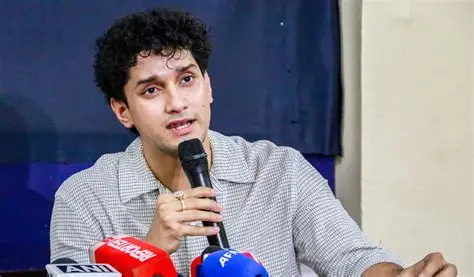
Saurav Das is an Indian investigative journalist, RTI activist, political spokesperson, and public policy advocate recognized for his work on transparency, governance, judicial accountability, and public interest issues. Best known for using India’s Right to Information (RTI) Act to uncover matters of public importance, Das has built a reputation through investigative reporting, civic activism, and contributions to national publications.
Born in New Delhi, he expanded his public role in 2026 after becoming the Chief Spokesperson of the Cockroach Janta Party (CJP), where he advocates for policies addressing youth issues, education, employment, and government accountability. His growing influence reflects the intersection of investigative journalism, civic engagement, and political advocacy in contemporary India.
Das combines rigorous data-driven reporting with legal interventions and public activism. His efforts often expose gaps in institutional accountability, from police actions to pandemic management and judicial processes. At a young age, he has influenced public discourse on democracy, transparency, and citizen rights in contemporary India.
Saurav Das Early Life
Saurav Das was born on 28 January 2000 in New Delhi, India, into a middle-class family. He grew up in the capital, where access to education and urban opportunities shaped his early worldview. His hometown remains New Delhi, reflecting deep roots in the city that later became central to his professional life.
Details about his family are limited in public sources, with mentions primarily of his mother. He maintains a private personal life, focusing public attention on his work rather than family background. Growing up in a diverse, politically aware environment in Delhi likely fueled his interest in governance and justice from a young age. He developed a non-vegetarian food habit and enjoys activities like traveling, reading, yoga, swimming, dancing, and regular gym sessions for fitness.
As a child and teenager in New Delhi, Das witnessed India’s vibrant yet complex democratic landscape, including debates on rights, media, and institutional roles. These experiences laid the foundation for his later activism. By his late teens, he showed a strong inclination toward questioning authority and seeking information, traits that defined his career.
New Delhi, as the political heart of India, exposed him to national issues like policy decisions, protests, and judicial matters. This environment nurtured his commitment to transparency and accountability, values he would champion professionally. His early life in a bustling metropolis equipped him with an understanding of urban challenges, including pollution and governance, which he later addressed publicly.
Saurav Das Education
Saurav Das pursued higher education at Amity University in Noida, completing a Bachelor of Arts in Journalism and Mass Communication from 2016 to 2019. This program provided formal training in media, research, and communication, aligning perfectly with his emerging interest in investigative work.
During college, Das began applying classroom knowledge to real-world issues. At age 17, he decided to focus on investigative journalism. By 18, he gained attention through RTI filings that uncovered significant stories. These early efforts during his university years bridged academic learning and practical activism, setting him apart from peers.
His time at Amity University honed skills in reporting, data analysis, and ethical journalism. The curriculum likely covered media law, public affairs, and research methods, tools he used extensively later. College also offered opportunities for seminars, discussions, and networking that supported his transparency advocacy.
Education in the National Capital Region gave Das proximity to government institutions, courts, and media houses in Delhi and Noida. This location facilitated internships and early RTI work. His academic background equipped him to navigate complex legal and policy environments, evident in his later court interventions and detailed investigations.
Saurav Das Career
Saurav Das built his career as an independent investigative journalist emphasizing law, governance, judiciary, crime, and transparency. His professional journey started with hands-on experience and evolved into influential reporting and activism.
Early Professional Steps
In December 2018, during his final college year, Das interned at the News Desk of NDTV in New Delhi until January 2019. This short stint provided insight into newsroom operations and broadcast journalism.
In August 2020, he began working as a freelance independent journalist. He also held roles like Video Post-Producer at Monks (October 2021 to April 2022) in Noida and Content Associate at GLG in Gurugram (May 2022 to March 2023), where he conducted financial research on American companies.
RTI Activism and Investigative Reporting
Das’s RTI activism began in 2017 at age 18. He filed numerous applications to access public records on governance and accountability matters. Many disclosures gained national attention, covered by major media outlets.
Key examples include RTI efforts on the Aarogya Setu app during COVID-19. He challenged government responses through filings and a writ petition in the Delhi High Court (W.P.(C) 10873/2020), pushing for transparency in pandemic data and app development. This contributed to the Central Information Commission expediting related appeals.
He filed over 40 RTIs for an investigation into extrajudicial police killings in Uttar Pradesh, supported by a Pulitzer Center grant. Analyzing thousands of National Human Rights Commission documents, the work exposed issues with encounter narratives and Supreme Court guidelines. It appeared in New Lines Magazine in 2024.
Das regularly contributes to outlets like The Caravan, Article 14, Al Jazeera, The Wire, The Hindu, New Lines Magazine, Frontline (with his “Case In Point” column), The Quint, BoomLive, Firstpost, and LiveLaw. Topics include judicial accountability, police actions, RTI challenges, and governance.
Notable pieces cover pending habeas corpus petitions in the Supreme Court, RTI law’s weakening, politically sensitive case assignments, and PMLA issues. He has highlighted delays in courts undermining RTI and transparency in high-profile matters.
Legal Interventions and Public Interest Work
Beyond reporting, Das engages in litigation for transparency. He files public interest litigations (PILs) on accountability and has pursued cases like access to police charge sheets in the Supreme Court, represented by Prashant Bhushan.
During the pandemic, his Madras High Court petition influenced CIC processes. He continues using courts to overcome information barriers.
Climate Action and Other Initiatives
Saurav Das co-founded the Climate Action Front, reflecting broader civic involvement. In November 2025, he co-led anti-pollution protests at India Gate in Delhi. He participated in the World Expression Forum in Norway.
In 2024, the Young India Foundation recognized him among “30 Young Indians Transforming The World’s Largest Elections In 2024.”
Role in Cockroach Janta Party
In June 2026, Das was appointed Chief Spokesperson of the Cockroach Janta Party (CJP), founded by Abhijeet Dipke as a satirical yet serious youth movement responding to remarks about unemployed youth. Alongside spokespersons like Vijeta Dahiya and Ashutosh Ranka, he helps drive demands for education reforms and ministerial accountability, such as calls for the resignation of Union Education Minister Dharmendra Pradhan over issues like NEET-UG controversies.
His announcement on X emphasized youth frustration and the need for change. Under his involvement, CJP evolved from a social media phenomenon into organized protests, including plans at Jantar Mantar. He later announced additional spokespersons to strengthen the movement.
Das’s transition reflects a blend of journalism and advocacy, using his platform for systemic reform.
The Origins of CJP: How a Remark Sparked a Movement
To fully understand Das’s political turn, it helps to know how the Cockroach Janta Party itself came about. The movement was founded on May 16, 2026, by Abhijeet Dipke, a political communications strategist previously associated with the Aam Aadmi Party. CJP emerged directly in response to a remark made a day earlier by Chief Justice of India Surya Kant, who compared unemployed youth to “cockroaches” and “parasites of society.” The name Cockroach Janta Party is itself a pointed parody of the ruling Bharatiya Janata Party, and its slogan, “Voice of the Lazy & Unemployed,” reclaims the insult as a rallying cry.
Despite not being registered with the Election Commission of India, the movement spread rapidly, drawing hundreds of thousands of sign-ups and tens of millions of social media followers within weeks, along with real-world activity such as protests and clean-up drives where volunteers dressed in cockroach costumes. It was into this fast-growing, unconventional movement that Das stepped as Chief Spokesperson in June 2026, alongside fellow spokespersons Vijeta Dahiya and Ashutosh Ranka.
From Jantar Mantar to a Parliament Standoff
Through July 2026, CJP’s protest activity intensified considerably, and Das became one of its most visible public-facing figures. The movement’s sit-in at Delhi’s Jantar Mantar, centered on grievances including competitive-exam failures (notably the NEET-UG controversy), youth unemployment, and calls for accountability from Union Education Minister Dharmendra Pradhan, grew into a broader push. As part of this, a CJP delegation that included Das met twice with Union Health Minister J.P. Nadda to present a set of core demands.
Tensions escalated on July 20, 2026, the opening day of Parliament’s Monsoon Session, when CJP activists attempted to march from Jantar Mantar toward Parliament House without police authorization. Delhi Police, who had said days earlier that the march would not be permitted, used a mild lathi charge to disperse the crowd, and Das was taken to the Deputy Commissioner’s office as authorities and CJP representatives sought to negotiate. Speaking to reporters at the time, Das described the situation as an ongoing dialogue between the movement and the government rather than a confrontation.
A Movement Entwined With Sonam Wangchuk’s Hunger Strike
The Parliament march standoff unfolded alongside, and became closely linked to, a 26-day hunger strike by climate activist and engineer Sonam Wangchuk, whose health struggles drew nationwide attention and sympathy for the broader protest cause. As pressure mounted, both Wangchuk and CJP scaled back their original demands; notably, the call for Education Minister Dharmendra Pradhan’s resignation was dropped from the movement’s public list of conditions. By July 24, 2026, the government had signaled openness to holding talks at a neutral venue and indicated it would not pursue cases against those who had protested peacefully, while Wangchuk ended his hunger strike after an appeal from Prime Minister Narendra Modi. Das, in his role as Chief Spokesperson, remained a key point of contact for CJP throughout these negotiations.
Saurav Das Achievements
Saurav Das has several notable achievements. His RTI-driven stories have influenced public debate and policy scrutiny. The Pulitzer Center-supported investigation on police encounters stands out for its depth.
Recognition from the Young India Foundation in 2024 highlights his electoral and democratic impact. His Frontline column provides consistent analysis on transparency. Legal efforts, like those on Aarogya Setu and habeas corpus disclosures, advanced information access.
Participation in protests and international forums like the World Expression Forum demonstrates his growing public role. Appointment to CJP leadership marks a significant milestone in youth political engagement.
Saurav Das Awards
Saurav Das received recognition as one of the “30 Young Indians Transforming The World’s Largest Elections In 2024” by the Young India Foundation. This award acknowledges his contributions to democratic discourse through journalism and activism.
While specific traditional journalism awards are not extensively documented in available sources, his work’s impact—featured across national and international platforms and driving legal and public actions—serves as a form of professional validation.
Saurav Das Personal Life
Saurav Das is unmarried and based in New Delhi. He keeps family details private, focusing public attention on professional endeavors. He enjoys fitness, travel, reading, yoga, swimming, and dancing. He is occasionally seen enjoying alcoholic beverages socially.
His religion is Hinduism, and he follows a non-vegetarian diet. Social media presence on platforms like X (formerly Twitter), Instagram, and LinkedIn helps him engage with audiences on issues he covers.
Das balances intense professional demands with personal interests that support his well-being and creativity.
Saurav Das State of Origin and Connection to New Delhi
Saurav Das hails from New Delhi, the National Capital Territory of India. As a Delhiite, he embodies the city’s dynamic mix of politics, media, education, and activism. Delhi’s role as India’s political center provided direct access to institutions he scrutinizes, from Parliament and ministries to the Supreme Court and High Court.
New Delhi’s diverse population and history of movements influenced his focus on governance and rights. Challenges like air pollution, which he protested against in 2025 at India Gate, are personal given his roots. His work often reflects urban Indian realities while addressing national issues. Delhi’s vibrant civil society and media ecosystem nurtured his career from college internships to independent journalism and CJP leadership.
Other Relevant Aspects of Saurav Das Work
Saurav Das maintains a strong online presence, using X to share findings, RTIs, and commentary. His handle @SauravDassss has a significant following, amplifying his investigations.
He is working on or has published the book Complicit Silence: The Court’s Role in India’s Quiet Suffering, examining the judiciary’s role in democratic challenges under the current regime, featuring victim narratives.
Das advocates open governance, filing RTIs on ministerial communications, judicial delays, and more. His columns critique institutional weakening, such as the RTI regime’s condition after 20 years.
Saurav Das’s Balancing Act: Journalist and Political Spokesperson
Das’s dual identity, as an independent investigative journalist and as the public face of an active protest movement, has drawn its own share of commentary. Unlike traditional party spokespeople, he continues to be introduced in media coverage first and foremost by his journalism credentials: his RTI activism, his Pulitzer Center-supported reporting on police encounters, and his regular bylines. That background has arguably lent CJP’s messaging a distinct, fact-driven register compared to conventional political rhetoric, even as the movement itself leans on satire and viral social media energy.
This overlap between reporter and advocate is unusual in Indian public life, and it has made Das a frequent subject of profile pieces asking, in effect, “who is the man behind the cockroach mask?” These pieces trace his path from teenage RTI filer to nationally recognized protest spokesperson in under a decade.
Read Also: Ebiere Soberekon Biography: Age, State of Origin, Husband, Wedding Day, Career, Net Worth & Family
Conclusion
Saurav Das represents a new generation of Indian voices committed to transparency and accountability. From early RTI filings in college to leading CJP advocacy, his path demonstrates dedication to public interest. As India navigates complex democratic challenges, figures like Das continue pushing for informed citizenry and responsive institutions. His ongoing work in journalism, activism, and politics will likely shape future discourse on governance and youth empowerment.
FAQs
Who is Saurav Das?
Saurav Das is an investigative journalist and the Chief Spokesperson of the Cockroach Janta Party. He is known for his work on governance, judiciary, and transparency issues in India.
What is the date of birth of Saurav Das?
Saurav Das was born on 28 January 2000.
Where was Saurav Das born?
He was born in New Delhi, India.
What is Saurav Das educational qualification?
He holds a Bachelor of Arts in Journalism and Mass Communication from Amity University, Noida (2016-2019).
What is Saurav Das role in Cockroach Janta Party?
He serves as the Chief Spokesperson, helping lead the party’s efforts on youth issues, education, and accountability.
Has Saurav Das written a book?
He has worked on Complicit Silence: The Court’s Role in India’s Quiet Suffering, exploring judicial roles in contemporary India.
What are some key investigations by Saurav Das?
Notable works include probes into police encounters in Uttar Pradesh, Aarogya Setu transparency, and RTI-related governance issues.