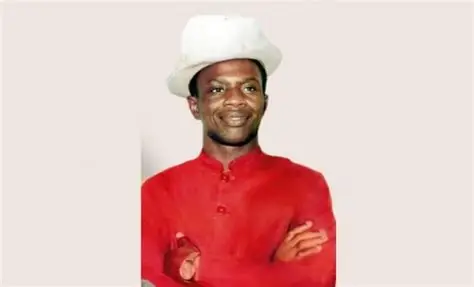
Celestine Onwurah Ukwu was a Nigerian highlife musician, singer, songwriter, composer, and bandleader widely regarded as one of the most influential pioneers of Igbo highlife music. Best known for blending traditional Igbo rhythms with sophisticated highlife arrangements, Celestine Ukwu created timeless songs that explored themes of wisdom, humility, equality, patience, and the fleeting nature of material wealth.
Born in Enugu and raised in Abor, present-day Enugu State, Nigeria, he became one of the defining voices of southeastern Nigerian music during the 1960s and 1970s through classics such as “Ije Enu,” “Igede,” and “Money Palava.” Although his life was cut short at a young age, his rich musical legacy continues to inspire generations of artists and remains a cornerstone of Nigerian highlife.
His career unfolded against the backdrop of Nigeria’s independence years and the civil war that followed. After training as a teacher and gaining early experience in several regional bands, he formed his own groups and built a distinctive style that mixed guitar, vibraphone, pedal steel, and soft vocal harmonies. The result was music that comforted a generation recovering from conflict and still speaks to audiences who value thoughtful songwriting. This biography traces his path from childhood in Enugu State through his musical achievements, personal life, and enduring influence.
Celestine Ukwu Early Life
Celestine Onwurah Ukwu was born on 27 June 1940 in Enugu, then part of the Colony of Nigeria. His parents were Anigbogu Justus Ukwu and Udenwo Nwokpoko Ukwu, peasant farmers from Umuavulu-Abor in the Udi Local Government Area of Enugu State. His mother had lost several earlier children in infancy, and his father gave him the name Onwurah, meaning “Death, keep off,” as an expression of hope that this child would survive.
The family lived simply, yet music filled their home. His father performed traditional Igbo genres such as igede, ikpa, and ode, while his mother led a women’s singing group. His grandmother was a folk musician and dancer. From an early age Celestine absorbed these sounds and the values they carried.
He grew up in Umuavulu-Abor, a community rich in Igbo customs. As a boy he loved Egwu-Odo, the traditional dance, and learned to play the ngedegwu, a xylophone-like instrument made of trimmed woods placed across a log or banana trunk and struck with sticks. The instrument held sacred associations with masquerades and could even be used to call names in coded communication. Celestine became skilled at it and later carried elements of that sound into his professional work.
He was known as a cheerful, honest, and soft-spoken child who was also energetic and quick to learn. At St. Peter’s Primary School in Abor he led the shakpala music group that used bottles and other local instruments, and he later headed the Amakekwu music group formed by his age mates.
An uncle, Vincent Ukwu, a choir member and bandmaster at St. Mary’s Catholic Church in Port Harcourt, took the boy to live with him for a time. There Celestine attended the mission school, completed parts of his primary education, and regularly accompanied his uncle to church rehearsals and Mass. Another uncle, Felix Okololagwu Ukwu, a teacher, later took him to Maiduguri and then to Zaria. These moves exposed him to different regions of Nigeria and to new musical influences while he continued to develop his interest in both traditional and church music. By the time he finished primary school in Abor in 1955, music had already become central to his identity.
Celestine Ukwu Education
After primary school Celestine spent three years at the Teacher Training College in Zaria. In 1958 he obtained his Teachers’ Grade Three Certificate and began teaching. His time in the north of Nigeria broadened his experience of the country and of different languages; he later spoke Igbo, English, Hausa, Efik, and Pidgin English with ease. Teaching provided a steady path, yet the call of music grew stronger.
He taught for a short period before deciding that performance and composition offered the fuller expression of the gifts he had received from his family and community. The formal training he received in reading music and playing the harmonium under his uncle’s guidance proved useful when he later arranged songs for larger ensembles. His education, both formal and informal, therefore combined practical classroom skills with deep immersion in Igbo musical traditions and the discipline of written notation.
Celestine Ukwu Career
Celestine left teaching and returned to Enugu in 1962. He joined Mike Ejeagha’s Paradise Rhythm Orchestra as a vocalist and maraca player. In that group he also learned to play the odo, or xylophone, an instrument that would remain important in his later arrangements. He soon moved on, joining Mr. Picolo’s band for a tour of the Democratic Republic of the Congo.
The exposure to Congolese guitar styles, especially the work of Nicolas Kasanda, left a clear mark on his own playing and arranging. Upon returning to Nigeria he performed briefly with Herbert Udemba and his African Baby Party. He then formed the Freedom Jazz Band in Maiduguri, later moved to Zaria to form The Republican Knights with Charles Jebba, and eventually settled in Onitsha where he fronted the Niger City Starlighters.
With the Starlighters he recorded early songs that found local success, among them “No Condition is Permanent,” “Artificial Beauty,” “Appolonia,” and “Ije Enu.” “Ije Enu” sold strongly and became one of his signature pieces. After about nine months he regrouped the musicians under a new name, Celestine Ukwu and His Music Royals of Nigeria.
The band played regularly at the Frontline Hotel in Onitsha, whose owner Mathias Okafor helped by renting instruments. The Music Royals developed a following across the Eastern Region and even toured neighboring countries and West Germany. Their sound was already distinguished by soft pacing, careful vocal harmonies, and thoughtful lyrics.
Formation of the Philosophers National
The Nigerian Civil War interrupted everything in 1967. Non-Biafran members of the band left, and Celestine recorded the patriotic song “Hail Biafra” to support morale. When the war ended in 1970 he assembled a new group that he named Celestine Ukwu and His Philosophers National. The name reflected his desire to offer more than entertainment; he wanted his music to carry ideas about how people should live. Students at the University of Nigeria Nsukka later reinforced the title by crowning him an ambassador of philosophy during a memorable campus performance. The Philosophers National released a steady stream of albums and singles through the mid-1970s, establishing Celestine as one of the leading voices in Igbo highlife.
Musical Style and Themes
Celestine’s highlife stood apart from the more driving styles of some of his contemporaries. He favored relaxed tempos, shimmering vibraphone, pedal steel guitar, and keyboard textures woven carefully into the traditional highlife framework of guitar, percussion, and brass. Vocal harmonies were clean and group-oriented rather than dominated by elaborate improvisation.
Lyrics were written mainly in Igbo, with occasional Efik and Pidgin English. Themes returned again and again to the uncertainty of life, the equality of people before God, the emptiness of unchecked materialism, the value of hard work, the need for faith and patience, and the importance of peace and forgiveness. Songs such as “Grade by Grade” affirmed that no one is born destined to poverty or wealth; effort and providence determine outcomes. “Ego Eju Aka” warned that money never fills the hand or the stomach. “Ije Enu” reminded listeners that circumstances change and that today’s rejoicing or mourning is not permanent. These messages resonated strongly with audiences still recovering from war and displacement.
Albums and Songs
Celestine released seven albums and more than forty songs. The albums include True Philosophy (1971), Tomorrow is so Uncertain (1973), Ndu Ka Aku (1974), Ilo Abu Chi (1974), Ejim Nk’onye (1975), and Igede Fantasia (1976). A compilation titled His Philosophies appeared in 1975. Notable songs include Ije Enu, Igede, Money Palava, Uso Ndu, Onwunwa, Ife si na Chi, Ilo Oyi, Uwa bu Olili, Elege, Ejina Uwa Nya Isi, Okwukwe Na Nchekwube, Ndu Ka Aku, Ego Eju Aka, Grade by Grade, and Uwem Ereri Mbot Emi. Many of these tracks have appeared on later world-music compilations such as The Rough Guide to Highlife and The Rough Guide to Psychedelic Africa, confirming their lasting appeal beyond Nigeria.
Celestine Ukwu Personal Life
In 1976 Celestine married Josephine Uzoyibo Okereke-Attah, a student at the School of Health in Oji-River, Enugu State. She came from a neighboring hamlet in his hometown area. Friends and family remembered him as a loving and attentive husband who, despite frequent tours, made time to visit her at school and who treated his in-laws with respect and kindness. He was soft-spoken, gentle, humble, and contented. Outside music he enjoyed sports and was regarded as a peacemaker and a man of intelligence.
He believed his purpose was to preach through song about the basic laws of living: love for God and love for neighbors. At the time of his death his wife was pregnant. Their daughter, Cynthia Chikwado Ada Ukwu, was born in December 1977 and later became a lawyer. She has continued to honor her father’s memory through the Celestine Ukwu Memorial Foundation.
Celestine Ukwu State of Origin and Cultural Roots
Celestine’s roots lay deep in Enugu State in southeastern Nigeria. Enugu takes its name from the Igbo words meaning “hill top,” reflecting the undulating landscape of the region. The city of Enugu itself grew around coal mining in the early twentieth century and later served as capital of the short-lived Republic of Biafra, earning it the informal title “capital of Igboland.” The surrounding areas, including Udi Local Government Area, are home to communities that maintain strong Igbo traditions of communal living, respect for elders, hospitality, and hard work. Abor, specifically Umuavulu-Abor, is a town of several villages located near the old Enugu-Nsukka Road.
Its people practice farming and uphold festivals, masquerade performances, and musical forms such as igede and ode that shaped Celestine’s earliest listening. The broader Igbo worldview that appears in his songs, the emphasis on personal effort, the suspicion of pure materialism, and the acceptance of life’s transience, is consistent with the cultural values of this part of southeastern Nigeria. Growing up amid these traditions gave him both the musical vocabulary and the philosophical outlook that defined his work.
Celestine Ukwu Awards and Recognition
Formal national awards were not widely documented during Celestine’s short career, yet recognition came in other meaningful forms. Music critic Benson Idonije of Radio Nigeria Two described him as a prolific and outstanding composer whose soft, reflective style set him apart. At the University of Nigeria Nsukka students crowned him Ambassador of Philosophy after a memorable performance. His songs have been included in respected international compilations, and ethnomusicologists and scholars have analyzed his lyrics for their social commentary and cultural depth.
After his death a memorial band continued for a time, and decades later his daughter established the Celestine Ukwu Memorial Foundation to preserve his legacy through talent development, skills training, and programs that promote the moral values found in his music. These ongoing tributes confirm that his contribution to Igbo highlife and to Nigerian popular culture has been widely acknowledged.
Celestine Ukwu Death and Immediate Aftermath
On 7 May 1977 Celestine and his friend Alexander Nwobodo were traveling toward Ihiala in Nwobodo’s newly purchased car. Near Owerri Road in Ogidi they were struck by a trailer. Both men were taken to hospital, where they died from their injuries. Celestine was only thirty-six or thirty-seven years old. He left behind his pregnant wife, his parents, and younger siblings. The news shocked the music community and many ordinary listeners who had found comfort in his songs. T
ravel papers for an international engagement had already been prepared, underscoring how much potential remained unrealized. In the months that followed, band members continued briefly under the name Celestine Ukwu Memorial Dance Band, led by vocalist Anthony Mogbo, known as Buzuzu. The sudden end of his life only deepened the sense that his thoughtful voice had been silenced too soon.
Celestine Ukwu Legacy
More than four decades after his death, Celestine Ukwu’s music continues to be played and discussed. Younger listeners discover the gentle grooves and clear messages through digital platforms and reissues. Scholars point to the way his songs addressed the social changes that followed the civil war, including the rise of individual materialism at the expense of communal values.
His integration of traditional instruments and themes into a modern highlife format helped keep Igbo musical identity alive during a period of rapid change. The Celestine Ukwu Memorial Foundation carries forward the spirit of his work by supporting young talent and encouraging the same ethical reflection that marked his compositions. In this way the philosopher-musician of Abor remains present in Nigerian cultural life.
Read Also: Ebiere Soberekon Biography: Age, State of Origin, Husband, Wedding Day, Career, Net Worth & Family
Conclusion
Celestine Onwurah Ukwu’s life was brief yet rich in purpose. From a childhood filled with traditional music in Abor to the stages of Onitsha, Enugu, and beyond, he developed a distinctive highlife style that married soft instrumentation with lyrics of lasting wisdom. His albums and songs offered consolation after war and continue to invite reflection on equality, patience, and the proper place of material things.
Though a car accident cut short his career in 1977, the body of work he left behind has secured his place among the most thoughtful voices in Nigerian popular music. Listeners who return to “Ije Enu,” “Igede,” or “Money Palava” still find guidance and beauty in the music of the man from Umuavulu-Abor.
FAQs
Who was Celestine Ukwu?
Celestine Onwurah Ukwu was a Nigerian Igbo highlife musician, composer, and bandleader active in the 1960s and 1970s. He is remembered for thoughtful songs such as “Ije Enu,” “Igede,” and “Money Palava” and for leading the groups Music Royals and Philosophers National.
When and where was Celestine Ukwu born?
He was born on 27 June 1940 in Enugu, Nigeria, and raised in Umuavulu-Abor in the Udi Local Government Area of Enugu State.
What are Celestine Ukwu’s most famous songs?
Among his best known works are “Ije Enu,” “Igede,” “Money Palava,” “Ego Eju Aka,” “Grade by Grade,” “Elege,” and “Okwukwe Na Nchekwube.”
How did Celestine Ukwu die?
He died on 7 May 1977 from injuries sustained in a car accident near Ogidi on the Owerri-Onitsha Road while traveling with a friend.
Did Celestine Ukwu have a family?
Yes. He married Josephine Uzoyibo Okereke-Attah in 1976. Their daughter, Cynthia Chikwado Ada Ukwu, was born after his death and has worked to preserve his legacy.
What made Celestine Ukwu’s music unique?
His highlife style featured relaxed tempos, vibraphone, pedal steel guitar, and clear group vocal harmonies. The lyrics focused on philosophical themes drawn from Igbo values, setting his work apart from more purely celebratory highlife of the period.
Are Celestine Ukwu’s albums still available?
Yes. Several original albums have been reissued or appear on compilation collections, and individual tracks are widely available on digital music platforms.