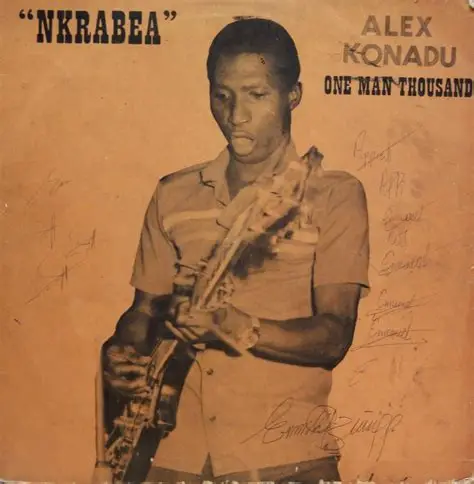
Alex Kwabena Konadu, popularly known as One Man Thousand, was a legendary Ghanaian highlife singer, songwriter, and guitarist who left a lasting mark on African music. Celebrated for his captivating stage performances, rich storytelling, and powerful songs in the Asante Twi language, Konadu became one of Ghana’s most influential highlife musicians.
Throughout his career, he blended traditional rhythms with meaningful lyrics that reflected everyday life, cultural values, and social issues, earning widespread admiration across Ghana and beyond. His remarkable contributions helped preserve and promote highlife music while inspiring generations of artists. This article explores Alex Konadu’s biography, music career, achievements, personal life, and enduring legacy.
Born in the Ashanti Region, Konadu remained loyal to the pure guitar highlife tradition even as other styles rose and fell around him. His work focused on everyday human experiences, loss, destiny and community values. Over more than three decades he recorded many albums, performed tirelessly and left a body of music that continues to be played at funerals, celebrations and gatherings. This biography traces his journey from a small Ashanti village to national recognition as one of the leading voices of Ghanaian highlife.
Alex Konadu Early Life
Alex Kwabena Konadu was born in 1948 in Adwumakase Kese, a village in the Kwabere No. 3 District of the Ashanti Region of Ghana. Some records list the year as 1950, yet his death in 2011 at the age of sixty three aligns with the earlier date. The village sits in the heart of Ashanti land, an area rich in history, tradition and cultural pride.
From a young age Konadu showed a strong interest in music. While still in school he watched concert parties and dance bands that visited his town. He could not yet join any group, so he taught himself the basics of the instruments he saw and listened closely to the melodies and rhythms that filled the air during those performances.
His parents featured in local life and the community around him valued music as part of daily expression and social events. Elementary education ended for him in 1967. Rather than continue formal studies, he chose music as his path. The decision reflected both personal passion and the limited opportunities for advanced schooling in rural Ashanti at the time. Those early years of observation and self practice laid the foundation for the clear voice and skilled guitar work that later defined his sound.
Alex Konadu Education
Formal schooling for Alex Konadu stopped at the elementary level. He completed his basic education in 1967 in the Ashanti Region. No records show attendance at secondary school or any tertiary institution. Instead of classroom learning, he gained knowledge through direct experience with musicians and bands. He watched performers, studied their techniques and practiced on his own. This practical education proved more valuable for his career than further academic study would have been. In the Ghana of that era many talented artists followed a similar route, learning by immersion in the living tradition of highlife and concert party music rather than through formal music schools.
Alex Konadu Ashanti Heritage and State of Origin
The Ashanti Region holds a central place in Ghanaian history and identity. It is the traditional heartland of the Asante people, whose kingdom once controlled vast areas of the Gold Coast through military strength, trade in gold and kola nuts, and a sophisticated political system centered on the Golden Stool. Kumasi, the regional capital, remains a major commercial and cultural hub. The region is known for its dense forests, rich farmlands that produce cocoa, and a deep respect for customary law and festivals.
Adwumakase Kese lies within what is now part of the Afigya Kwabre area, not far from Kumasi. Life in such villages during Konadu’s youth revolved around farming, family compounds, and community events where music played a key role. Highlife itself grew from a mix of local Akan rhythms, palm wine guitar styles, and influences that arrived through coastal trade and colonial contact.
By singing exclusively in Twi, the language of the Asante, Konadu kept his work rooted in the speech and proverbs of his people. His music carried the values of the region: respect for elders, reflection on fate, and the importance of social bonds. The nickname One Man Thousand itself echoes the Ashanti appreciation for a single person who can gather and move a crowd through skill and presence.
Alex Konadu Career
Alex Konadu entered professional music through a series of local bands before establishing his own group. His path shows steady growth from supporting roles to leadership and national fame.
Early Band Experience
He first joined the Kantamanto Bosco Group. From there he moved to the band of Kwabena Akwaboah, a known figure in the concert party and highlife scene. He stayed with Akwaboah’s group for three years, sharpening his skills as a singer and guitarist. After that period he became lead vocalist of the Happy Brothers Band. Two years with that outfit confirmed his readiness to step out on his own.
Formation of His Own Band
Around the early 1970s Konadu began working as a solo artist. He composed new material and rehearsed carefully. He then invited A. K. Brobbey, a record dealer and producer, to hear his work. Brobbey recognized the talent, signed him, and helped organize a full band equipped with quality instruments. The new group focused on uptempo guitar highlife. Success came quickly. In 1976 the Entertainment Critics and Reviewers Association of Ghana named the band Best Guitar of the Year. That recognition marked the start of Konadu’s rise as a major figure in the genre.
Rise to National Fame
Konadu’s ability to attract large audiences wherever he appeared earned him the lasting nickname One Man Thousand, sometimes rendered as One Man Army or One Man 1000. Observers claimed he performed in virtually every town and village in Ghana. His shows were energetic, long and filled with interaction.
He stayed true to roots highlife, avoiding heavy experimentation with Afrobeat or other emerging styles. Singing in Twi, he addressed themes of love, loss, destiny, social behavior and the challenges of daily life. His music became especially associated with funerals because of the emotional weight of songs that spoke about death and remembrance.
Later Career and International Reach
Throughout the 1970s, 1980s and beyond Konadu released a steady stream of recordings on labels such as Brobisco House of Music. He also performed outside Ghana. A notable release was the 1988 live album One Man Thousand Live in London on the World Circuit label. That recording captured the energy of his stage presence for international listeners. He continued touring and recording into the later years of his life, remaining a respected elder of highlife even as newer generations of musicians appeared.
Alex Konadu Musical Style and Influences
Alex Konadu worked firmly inside the guitar highlife tradition that had earlier been shaped by artists such as E. K. Nyame. After Nyame’s death, many regarded Konadu as the unofficial successor in the pure guitar highlife style. His arrangements featured clear guitar lines, steady rhythms and vocals that carried both melody and message. He favored storytelling lyrics rich in Akan proverbs and everyday observations. The music stayed melodic and danceable yet often carried a reflective or mournful tone suited to serious occasions.
He drew from the concert party tradition of Ghana, where drama, humor and music mixed on stage. At the same time he kept the sound rooted in local Akan sensibilities rather than chasing international fashions. Listeners praised the smoothness of his guitar work and the way his voice conveyed sincerity. Songs often unfolded at a pace that allowed the story to settle with the audience. This approach made his performances feel intimate even in large outdoor settings.
Alex Konadu Notable Songs and Albums
As a singer and bandleader Konadu released more than a dozen albums and many individual tracks that became standards. His most famous song remains Asaase Asa from the mid 1970s. The track tells of a real tragedy in which a man lost both his wife and sister when a tree fell on them. Dedicated to all who have lost loved ones, the song is still played at Ghanaian funerals. Other well known titles include Agyata Wuo, Fa Odo Behya Me, Nkrabea, Owuo Mpe Sika and Mene Me Aserene.
Key albums and collections associated with his name include:
• Abokyi (1977, Brobisco House of Music)
• Awoo Ne Awo (1977, Brobisco House of Music)
• Asaase Asa (mid 1970s)
• Agyata Wuo (1979)
• Nkrabea (1980, Brobisco House of Music)
• One Man Thousand Live in London (1988, World Circuit)
• The Greatest Classics (1998)
• The Best of Alex Konadu (One Man Thousand) Vol. 1 (1999)
• God’s Time is the Best
• Various later compilations and live recordings
These releases document both studio craft and the live energy that made him famous. Many of the songs continue to appear on highlife anthologies and streaming platforms.
Alex Konadu Awards
In 1976 the Entertainment Critics and Reviewers Association of Ghana honored Alex Konadu’s band as Best Guitar of the Year. That early recognition confirmed the quality of the uptempo highlife sound he and producer A. K. Brobbey had developed. While later formal awards are less widely documented, his standing among peers and the public served as ongoing acknowledgment of his contribution. After his death, tributes from musicians and cultural organizations continued to affirm the lasting value of his work.
Alex Konadu Personal Life
Public details about Alex Konadu’s private life remain limited. He kept the focus of interviews and public appearances on his music rather than family matters. He had children, and at least one son has been noted for continuing in music, performing some of his father’s material. Konadu lived much of his adult life connected to Kumasi and the Ashanti Region.
He maintained a strong sense of loyalty to Ghanaian culture and language. On 18 January 2011 he passed away in Kumasi at the age of sixty three. News of his death brought widespread mourning among highlife fans and fellow musicians. Tributes highlighted both his artistic skill and the personal integrity that kept him grounded in traditional values.
Alex Konadu Legacy and Cultural Impact
Alex Konadu left a clear mark on Ghanaian highlife. By refusing to dilute his sound with passing trends, he preserved a pure form of guitar highlife that later artists could study and draw from. His songs entered the everyday soundscape of Ghana, especially at funerals where Asaase Asa and similar tracks provide comfort and shared memory. The claim that he performed in every settlement in the country, whether strictly accurate or not, points to the extraordinary reach of his live work.
Younger musicians have cited him as an example of dedication and cultural rootedness. His recordings continue to be reissued and streamed, introducing new listeners to the Twi language highlife of the 1970s and 1980s. In academic studies of Akan proverbs in song lyrics, his work has served as source material. The nickname One Man Thousand remains a shorthand for a performer who could command attention through talent alone. His career shows how a village born artist, guided by observation, practice and the support of a perceptive producer, could become a national cultural figure.
Read Also: Ebiere Soberekon Biography: Age, State of Origin, Husband, Wedding Day, Career, Net Worth & Family
Conclusion
Alex Kwabena Konadu rose from a small Ashanti village to become one of the defining voices of Ghanaian guitar highlife. Through clear singing in Twi, skilled guitar work and an unwavering commitment to roots style, he created music that spoke directly to the experiences of ordinary people. His nickname One Man Thousand captured the magnetism of his performances, while songs such as Asaase Asa ensured that his work would outlive him. The albums he left behind and the memories of his tireless touring continue to enrich Ghanaian cultural life. His story remains a reminder of the power of local language, traditional forms and personal determination in the making of lasting art.
FAQs
Who was Alex Konadu?
Alex Kwabena Konadu was a Ghanaian highlife singer, songwriter and guitarist born in 1948 in Adwumakase Kese in the Ashanti Region. He became known as One Man Thousand for his ability to attract large crowds and for his pure guitar highlife style sung in the Twi language.
What is Alex Konadu best known for?
He is best known for the song Asaase Asa, which is regularly played at Ghanaian funerals, and for his energetic live performances across the country. He is also remembered for staying true to traditional highlife rather than following newer musical trends.
When and where did Alex Konadu die?
Alex Konadu died on 18 January 2011 in Kumasi, Ghana, at the age of sixty three.
What language did Alex Konadu sing in?
He sang in Asante Twi, the language of the Ashanti people, which helped keep his music closely tied to local culture and proverbs.
Did Alex Konadu receive any awards?
Yes. In 1976 his band was named Best Guitar of the Year by the Entertainment Critics and Reviewers Association of Ghana.
How many albums did Alex Konadu release?
He released more than a dozen albums over the course of his career, including studio recordings and a notable live album recorded in London.
What was the meaning of the nickname One Man Thousand?
The nickname referred to his remarkable ability to draw and hold large crowds wherever he performed, as if one man could equal a thousand in impact and presence.