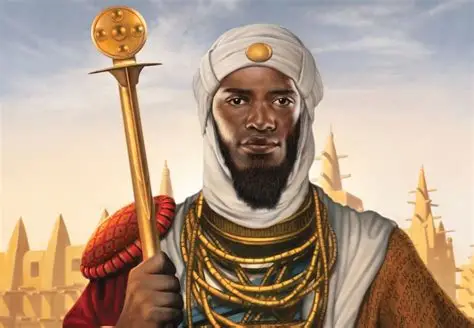
Mansa Musa (also known as Musa I or Kankan Musa) was the ninth Mansa of the Mali Empire in West Africa. He ruled from around 1312 to 1337 and is widely regarded as one of the wealthiest individuals in recorded history. His reign marked the zenith of the Mali Empire’s power, wealth, and cultural influence. Mansa Musa came from the Keita dynasty in the region of present-day Mali, an area rich in gold and salt resources that fueled extensive trade networks across Africa and beyond.
Through his devout practice of Islam and strategic leadership, Mansa Musa expanded the empire’s territory, promoted education and architecture, and brought global attention to West Africa with his legendary pilgrimage to Mecca. His journey in 1324 showcased immense riches that influenced economies in Egypt and the Middle East. Today, he remains a symbol of African prosperity, administrative skill, and cultural patronage in the medieval period.
Mansa Musa Early Life and Background
Mansa Musa was born around 1280 in the Mali Empire, likely near the capital of Niani along the upper Niger River. His full name was Musa Keita, with “Mansa” serving as the royal title meaning ruler or emperor in the Mandé language. He belonged to the Keita dynasty, which traced its roots to Sundiata Keita, the founder of the Mali Empire. Historical sources describe him as a grandnephew or close relative of Sundiata. His father was Faga Laye (sometimes referenced in connection with the royal line), and family ties linked him to key figures in the empire’s founding.
The Mali Empire at the time of his birth had already established itself as a powerful state following the decline of the Ghana Empire. It controlled vital trade routes for gold, salt, ivory, and other goods, connecting West Africa with North Africa and the Mediterranean. Mansa Musa’s early years unfolded in this prosperous environment, where the royal court emphasized governance, military training, and Islamic scholarship. Little detailed personal information survives about his childhood, as oral traditions and Arabic chronicles focus more on his later achievements.
Mali’s heartland lay in the savanna and riverine areas of West Africa, encompassing parts of modern-day Mali, with influence extending to neighboring regions. The Keita clan’s origins tied deeply to the Mandinka people, and the empire’s administration blended traditional African governance with emerging Islamic practices. Growing up amid this mix prepared Mansa Musa for leadership in a diverse, multi-ethnic realm.
Mansa Musa Rise to Power
Mansa Musa ascended to the throne around 1312 after the mysterious disappearance of his predecessor, Mansa Abu Bakr II (also known as Muhammad ibn Qu). Abu Bakr II reportedly launched large naval expeditions into the Atlantic Ocean with hundreds or thousands of ships to explore what lay beyond, but he never returned. Mansa Musa, serving as deputy, assumed full control in these circumstances. His accession received support from the nobility and military, allowing a smooth transition.
Upon taking power, Mansa Musa focused on consolidation and expansion. He commanded a professional army estimated at around 100,000 men, including a cavalry force of 10,000. Talented generals like Saran Mandian or Sagmandia assisted in campaigns. During his reign, the empire doubled in size, incorporating key cities such as Gao and Timbuktu and extending control over 24 additional cities with their surrounding districts. This growth made Mali one of the largest empires of its era, second only to the Mongol Empire in scale.
Mansa Musa Education and Religious Formation
Mansa Musa received education suited to a royal heir, including training in governance, military strategy, and Islamic studies. He became knowledgeable in Arabic, the language of scholarship and administration in the Muslim world. As a devout Muslim in the Maliki school of thought, he viewed Islam as a bridge to broader cultural and intellectual advancements. Chronicles note his commitment to Islamic principles, which shaped his policies on justice, charity, and learning.
This religious and scholarly foundation distinguished him among West African rulers. While earlier Mansas showed interest in Islam, Mansa Musa actively promoted it without forcing conversion on the broader population. He supported mosques, madrasas, and scholars, laying groundwork for Timbuktu’s rise as a center of learning. His education enabled effective administration over a vast territory and diplomatic engagement with North African and Middle Eastern powers.
Mansa Musa Military Campaigns and Territorial Expansion
Mansa Musa’s military efforts strengthened and enlarged the empire significantly. His forces subdued rebellions and conquered new territories, notably incorporating the Songhai kingdom’s capital at Gao. Generals extended influence eastward and westward, securing trade routes and resource-rich areas. The empire under his rule stretched roughly 2,000 miles, from the Atlantic coast to regions near Lake Chad, covering modern nations including parts of Mauritania, Senegal, Gambia, Guinea, Burkina Faso, Mali, Niger, Nigeria, and Chad.
This expansion brought stability and prosperity. Provinces received governors (farbas) accountable to the central authority, improving tax collection, law enforcement, and military recruitment. The professional standing army maintained peace, enabling focus on trade and cultural development. Mansa Musa’s leadership transformed Mali into a well-organized state with sophisticated administration.
Mansa Musa Economic Policies and Wealth Management
The foundation of Mansa Musa’s wealth lay in Mali’s control of gold and salt mines, along with dominance over trans-Saharan trade. The empire produced a substantial portion of the world’s gold supply at the time. Mansa Musa managed this resource wisely, using revenues to fund public works, military, and charitable efforts. Trade in gold, salt, ivory, copper, and slaves generated immense riches that supported urban growth and international commerce.
He reorganized economic administration through provincial governors and standardized practices that enhanced efficiency. The empire’s prosperity benefited citizens, with reports of good governance and adequate food supplies. Mansa Musa’s tangible wealth in gold contrasted with later financial systems and underscored Mali’s economic might.
Mansa Musa The Famous Hajj Pilgrimage to Mecca
In 1324, Mansa Musa embarked on his landmark pilgrimage (Hajj) to Mecca, a journey that lasted about two years and defined his legacy. The caravan included tens of thousands of people, estimates range from 15,000 to 60,000, comprising soldiers, officials, scholars, slaves, and attendants. Accompanying them were hundreds of camels laden with gold, with some accounts describing 80 to 100 camels each carrying 300 pounds of gold dust, plus slaves bearing gold staffs.
The procession passed through Walata, Tuat, and Cairo. In Cairo, Mansa Musa met the Mamluk Sultan and stayed for three months. His lavish gifts and spending flooded the market with gold, causing its value to depreciate significantly by up to 20% in some reports and taking over a decade for recovery. He distributed alms generously, purchased goods at high prices, and built relations with Egyptian leaders. The journey continued to Medina and Mecca, where he performed rituals, bought properties for future Malian pilgrims, and recruited scholars and architects.
On the return, he annexed Timbuktu peacefully and continued building projects. The Hajj elevated Mali’s prestige, fostering diplomatic and trade ties with the broader Muslim world. It also demonstrated Mansa Musa’s piety and generosity while inadvertently highlighting West Africa’s riches to Europe and the Middle East.
Mansa Musa Architectural and Cultural Contributions
Mansa Musa invested heavily in construction after his pilgrimage. He brought back architect Abu Ishaq al-Sahili (from Granada) and other experts, paying handsomely, including 440 pounds of gold for al-Sahili’s services. Major projects included the Djinguereber Mosque in Timbuktu, the mosque in Gao, and expansions in the capital Niani, such as the Hall of Audience and royal palace.
These structures, often built with mud-brick techniques adapted innovatively, combined functionality with grandeur. Timbuktu and Gao transformed into important urban centers. Sankore Madrasah evolved into a renowned university attracting students and teachers from across the Islamic world, teaching subjects like theology, law, history, and sciences. Libraries and mosques proliferated, making Timbuktu a hub of learning comparable to other great Islamic centers.
Mansa Musa Promotion of Learning and Scholarship
Mansa Musa prioritized education as a pillar of his reign. He recruited scholars, poets, and artisans from Egypt, Andalusia, and elsewhere. The University of Sankore became a focal point, exchanging knowledge with institutions in North Africa and the Middle East. This intellectual flowering boosted Mali’s reputation and integrated it more deeply into the Dar al-Islam.
Poets and chroniclers documented his era, while increased commerce brought new ideas. Mansa Musa’s support for Islamic education complemented traditional African knowledge systems, creating a vibrant cultural synthesis. Ibn Battuta later visited Timbuktu and praised its scholarly environment, reflecting the lasting impact of these initiatives.
Mansa Musa Awards and Recognitions
As a historical figure, Mansa Musa did not receive modern awards, but his achievements earned contemporary acclaim. Arab chroniclers like Al-Umari praised his justice, generosity, and administration. His depiction on the 1375 Catalan Atlas, holding a gold nugget, symbolized European awareness of his wealth and realm. Later historians regard him as a model ruler whose legacy influenced West African and Islamic history. His reign is often called the golden age of Mali.
Mansa Musa Personal Life
Details about Mansa Musa’s personal life remain limited in historical records. He married Inari Kunate (or Kankou), and they had a son, Maghan Musa, who briefly succeeded him. Some accounts mention a pious nature possibly linked to personal events, such as a rumored incident involving his mother, though these remain debated and unverified. He maintained a large court with officials, guards, and servants reflecting the empire’s scale.
Mansa Musa balanced royal duties with religious devotion. His household and court embodied the empire’s wealth through fine clothing, architecture, and ceremonies. He emphasized justice and welfare, contributing to reports of a well-governed society.
Mansa Musa Death and Immediate Succession
Mansa Musa died around 1337 at approximately age 57. His son Maghan succeeded him initially, followed later by other relatives. The empire continued for some time but gradually faced challenges from internal and external pressures. Mansa Musa’s death marked the end of an era of peak prosperity.
Mansa Musa Legacy and Historical Impact
Mansa Musa’s reign left enduring marks on Africa and the world. He elevated Mali’s status, promoted Islam, advanced architecture and education, and demonstrated the potential of organized African states. His pilgrimage introduced sub-Saharan Africa prominently to global audiences, influencing maps and trade perceptions for centuries. Modern estimates of his wealth, adjusted for inflation, often exceed $400 billion, underscoring his unparalleled economic position.
Timbuktu’s legacy as a scholarly center persisted, and his administrative models influenced successors. Today, Mansa Musa inspires discussions on African history, wealth, and leadership. He counters narratives of pre-colonial underdevelopment and highlights sophisticated empires in West Africa. His story appears in educational materials, documentaries, and cultural references worldwide.
The Mali Empire’s trade networks and cultural exchanges under his rule connected distant regions, facilitating the flow of goods, ideas, and people. Historians credit him with superior administrative gifts that sustained a vast, diverse polity. His emphasis on learning and piety set standards for governance blending faith and practicality.
Read Also: Ebiere Soberekon Biography: Age, State of Origin, Husband, Wedding Day, Career, Net Worth & Family
Conclusion
Mansa Musa stands as a towering figure in medieval history whose vision, wealth, and actions shaped West Africa and resonated far beyond. From his rise amid uncertainty to transformative rule and global pilgrimage, he exemplified effective leadership rooted in cultural pride and openness. His contributions to architecture, education, and economy created a golden age whose echoes endure. Mansa Musa’s life reminds us of Africa’s rich historical tapestry and the power of strategic patronage in building lasting legacies.
FAQs
Who was Mansa Musa and why is he famous?
Mansa Musa was the ruler of the Mali Empire known for his immense wealth derived from gold and his extravagant Hajj pilgrimage that drew international attention.
When and where was Mansa Musa born?
He was born around 1280 in the Mali Empire, in the region of present-day Mali near the Niger River.
What made Mansa Musa so wealthy?
Control over gold mines, salt trade, and trans-Saharan commerce generated his fortune, making Mali a dominant economic power.
What happened during Mansa Musa’s pilgrimage to Mecca?
His large caravan spent vast amounts of gold in Cairo, causing economic disruption, while he performed the Hajj and recruited experts for Mali.
Did Mansa Musa build universities?
Yes, he supported the development of Sankore Madrasah in Timbuktu into a major center of higher learning.
How large was the Mali Empire under Mansa Musa?
It spanned thousands of miles and included numerous modern countries in West Africa, reaching its territorial peak.
What is Mansa Musa’s legacy today?
He symbolizes African excellence, wealth, and cultural achievement, featured in historical studies and popular media.