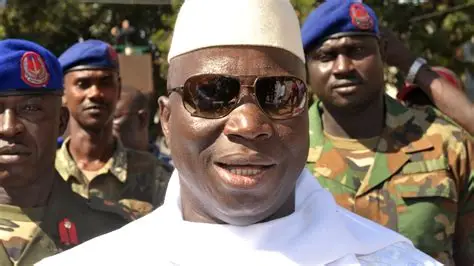
Yahya Abdul-Aziz Jemus Junkung Jammeh, widely known as Yahya Jammeh, is a Gambian politician and former military officer who served as the President of The Gambia from 1996 to 2017. Best known for seizing power in the 1994 bloodless military coup, Jammeh ruled the country for more than two decades, overseeing infrastructure expansion, agricultural initiatives, and rural development while drawing widespread international criticism over allegations of authoritarian rule, human rights abuses, and restrictions on political freedoms.
Born on May 25, 1965, in Kanilai, The Gambia, he remains one of the most consequential and controversial figures in the nation’s political history. This article explores Yahya Jammeh’s biography, military career, political leadership, achievements, controversies, personal life, and lasting legacy.
Jammeh left office in January 2017 after losing the 2016 presidential election to Adama Barrow. He went into exile in Equatorial Guinea. His presidency remains a subject of debate: supporters credit him with modernizing parts of the country and empowering certain communities, while critics point to documented abuses and repression. This biography examines his life, career, and legacy based on available historical records.
Yahya Jammeh Early Life
Yahya Abdul-Aziz Jemus Junkung Jammeh was born on 25 May 1965 in Kanilai village, Foni Kansala district, in the Western Division (now West Coast Region) of The Gambia. He was born shortly after The Gambia gained independence from Britain in February 1965. His parents were Abdul Aziz James Junkung Jammeh, a career wrestler, and Aja Fatou Ashombi Bojang, a housewife and trader. The family belongs to the Jola (also spelled Diola) ethnic group, a Muslim community with roots in the Casamance region of neighboring Senegal. His grandparents had migrated from there to Kanilai.
Kanilai, at the time of his birth, was a small rural village focused on farming, primarily rice, maize, and groundnuts. Life there involved agricultural labor in a region near the Senegalese border. The Jola people maintain strong cultural traditions, including community solidarity, wrestling, and Islamic practices. Jammeh grew up in this environment, experiencing rural Gambian life with its challenges of limited infrastructure and reliance on subsistence farming. He had close childhood ties in the village, including with relatives and friends like Mustapha James Kujabi.
The state of origin for Jammeh is the Foni Kansala district in the West Coast Region, a Jola-majority area. This region borders Senegal’s Casamance, sharing cultural and linguistic links with the Diola populations there. Historically, the area has seen cross-border movement and occasional tensions related to the Casamance conflict. Under Jammeh’s later influence, Kanilai transformed from a quiet farming settlement into a developed area with a presidential palace, hotel, game park, zoo, wrestling arena, and expanded agricultural projects. Villagers often viewed him as a benefactor who brought jobs, roads, and visibility to their community.
Jammeh’s early years shaped his identity as a Jola Muslim from a modest background. He often referenced his rural roots in speeches, positioning himself as a man of the people connected to traditional values. His family’s wrestling heritage and community focus may have influenced his later emphasis on physical fitness, hunting, and rural development initiatives.
Yahya Jammeh Education
Jammeh received his primary education at Kanilai Primary School (formerly St. Anthony’s) from around 1972 to 1976, followed by Saint Edwards Primary School in Bwiam from 1976 to 1978. He passed the Common Entrance Examination in 1978, earning a government scholarship. He then attended Gambia High School in Banjul from 1978 to 1983, where he completed his O-Level studies. He earned credits in subjects including Geography, English, French, Biology, and Physics, with passes in Chemistry and Oral English.
His formal education ended after secondary school. He did not pursue higher academic degrees before entering military service, though he later received military training and honorary titles. Jammeh often highlighted his rural schooling and self-made path, contrasting it with more urban or elite backgrounds in Gambian politics. He supported educational expansion during his presidency, including plans for a national university and scholarships for underprivileged students.
Yahya Jammeh Military Career
Jammeh joined the Gambia National Gendarmerie in April 1984 as a private. He progressed through ranks: promoted to sergeant in the Gambian National Army in 1986, served as an escort training instructor, and became a cadet officer in late 1987. He received a commission as second lieutenant in September 1989.
He held various roles, including service in the Presidential Guards (1989–1990), where he provided security for President Dawda Jawara. He commanded the Mobile Gendarmerie and Military Police units in 1991–1992, eventually becoming Officer Commanding of the Gambia National Army Military Police at Yundum Barracks. He received military police training at Fort McClellan, Alabama, in the United States (1993–1994), earning a diploma in military science. He also trained in Senegal and participated in regional peacekeeping efforts, such as in Liberia.
Jammeh’s military experience positioned him as a capable junior officer with exposure to international training. By 1994, as a lieutenant, he was part of a group of young officers dissatisfied with the long rule of President Jawara. This background directly led to his role in the 1994 coup.
Yahya Jammeh Rise to Power
On 22 July 1994, Jammeh and fellow junior officers led a bloodless coup that ousted President Sir Dawda Jawara, who had ruled since independence. The Armed Forces Provisional Ruling Council (AFPRC), with Jammeh as chairman, took control. The coup cited corruption, economic issues, and lack of progress under the previous government. It faced initial international criticism but received some domestic support amid perceptions of stagnation.
The AFPRC ruled by decree initially, promising a return to civilian rule. A transition period followed, including a new constitution. Jammeh retired from the army in 1996 and formed the Alliance for Patriotic Reorientation and Construction (APRC). He won the 1996 presidential election with about 56% of the vote, though observers noted irregularities. He was re-elected in 2001, 2006, and 2011.
Yahya Jammeh Presidency and Governance
Jammeh’s 22-year rule focused on infrastructure, agriculture, and rural development. Projects included road construction, telecommunications improvements, new schools, and a national television station. He promoted tourism and environmental efforts while building landmarks like Arch 22 in Banjul to commemorate the coup. In Kanilai, he developed farms, a zoo, hotel, and palace, turning it into a showpiece.
Economically, he advocated liberal market policies with state involvement in key sectors. He cultivated ties with countries like Taiwan (later switched), Libya, Cuba, and Iran. Gambia saw expansions in energy access and youth programs under his administration. The Jammeh Foundation for Peace supported education and poverty reduction.
He declared The Gambia an Islamic Republic in 2015, emphasizing his Muslim faith. Foreign policy included withdrawing from the Commonwealth in 2013 and initiating ICC withdrawal (later reversed). Supporters praised his anti-colonial stance and self-reliance focus.
Yahya Jammeh Achievements and Infrastructure Development
Achievements often cited include expanded road networks, school construction (16 new schools in early years), and agricultural initiatives. He invested heavily in his home region, creating employment through farms and projects. Gambia hosted regional summits, and he held positions like Chairman of CILSS and roles in OIC and ECOWAS.
Tourism promotion and wildlife projects in Kanilai aimed at economic diversification. He received various honors, including honorary doctorates and awards for leadership and humanitarian efforts, though some were controversial.
Yahya Jammeh Awards
Jammeh received numerous domestic and international recognitions, such as the Pan-African Humanitarian Award, Golden Star Award for leadership, and honorary titles from various organizations and countries. These included certificates from the US (e.g., honorary citizenship in Georgia) and awards from African and Asian bodies. Many reflected diplomatic ties during his rule.
Yahya Jammeh Controversies and Human Rights Record
Jammeh’s presidency faced significant criticism for authoritarian practices. The Truth, Reconciliation and Reparations Commission (TRRC) later documented serious violations, including extrajudicial killings, torture, enforced disappearances, and rape allegations involving him and associates like the “Junglers” hit squad. Cases included the 2004 killing of journalist Deyda Hydara, 2000 student protests, and the 2005 murder of West African migrants.
He claimed personal healing powers for HIV/AIDS and infertility using herbs, leading to concerns over public health. Policies toward journalists, opposition figures, and LGBT+ individuals drew international condemnation. Witch-hunting campaigns and executions on death row added to the record of abuses. Jammeh denied many allegations and has not faced formal charges.
Yahya Jammeh Personal Life
Jammeh is Muslim and has been married multiple times. He married Tuti Faal in 1994 (divorced 1998/1999). In 1999, he married Zeinab (Zineb) Suma Soumah, with whom he has two children: daughter Mariam and son Muhammad Yahya. In 2010, he married Alima Sallah (divorced around 2011–2012). Reports of additional marriages exist but vary in confirmation.
He enjoys tennis, soccer, hunting, reading, and animal rearing. His public image included prayer beads and a stick, projecting a devout and traditional persona. Family and village ties remained central, with Kanilai serving as a personal base.
Yahya Jammeh Post-Presidency and Exile
After initially contesting the 2016 results, Jammeh stepped down in January 2017 amid regional pressure, including from ECOWAS forces. He relocated to Equatorial Guinea with family and assets. Reports of frozen assets and corruption allegations followed, which he denies. He maintains some support in The Gambia, particularly in Jola areas.
Read Also: Ebiere Soberekon Biography: Age, State of Origin, Husband, Wedding Day, Career, Net Worth & Family
Conclusion
Yahya Jammeh’s life reflects the complexities of post-independence African leadership. From rural roots to military coup and long presidency, he left a mixed legacy of development in infrastructure and rural areas alongside serious governance and human rights challenges. His story highlights tensions between stability, ethnic representation, and democratic norms in The Gambia.
FAQs
Who is Yahya Jammeh?
Yahya Abdul-Aziz Jemus Junkung Jammeh is a former president and military officer of The Gambia who ruled from 1994/1996 to 2017.
When and where was Yahya Jammeh born?
He was born on 25 May 1965 in Kanilai village, Foni Kansala district, The Gambia.
What is Yahya Jammeh’s ethnic background and nationality?
He is Gambian of Jola (Diola) ethnicity and a Muslim.
How did Yahya Jammeh come to power?
He led a bloodless military coup in 1994 against President Dawda Jawara.
What were some of Yahya Jammeh’s key policies?
He focused on infrastructure, agriculture, education expansion, and rural development, while declaring The Gambia an Islamic Republic and pursuing independent foreign policy.
What controversies surround Yahya Jammeh’s rule?
The TRRC documented allegations of human rights abuses, killings, torture, and controversial health claims, which he denies.
Where is Yahya Jammeh now?
He lives in exile in Equatorial Guinea since 2017.
What is Kanilai’s significance to Yahya Jammeh?
It is his birthplace and home village, which he significantly developed during his presidency.