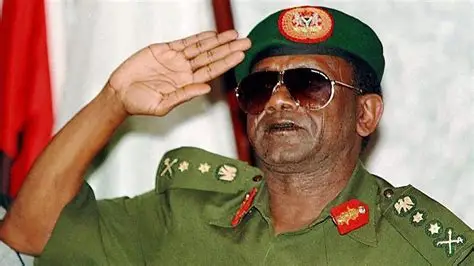
Sani Abacha was a Nigerian military officer and politician who served as the military Head of State of Nigeria from 1993 until his death in 1998. Widely recognized as one of the most influential and controversial leaders in Nigeria’s history, Abacha rose through the ranks of the Nigerian Army after playing key roles in several military coups that reshaped the country’s political landscape.
Born in Kano to a Kanuri family with roots in present-day Borno State, he led Nigeria during a period marked by economic reforms, political repression, international sanctions, and persistent allegations of human rights abuses and corruption. His administration continues to spark intense debate among historians, policymakers, and the public.
Abacha’s leadership came at a turbulent time for Nigeria, following the annulment of the 1993 presidential elections. He positioned himself as a stabilizing force but faced significant domestic and international criticism. Supporters credit him with certain infrastructure developments and economic measures, while critics highlight repression and the looting of state resources. His sudden death opened the path for a transition to civilian rule in 1999. This biography explores his life in detail, from his early years to his lasting impact on Nigeria.
Sani Abacha Early Life
Sani Abacha was born on September 20, 1943, in Kano, Kano State, Nigeria. He belonged to a Kanuri ethnic family originally from what is now Borno State in northeastern Nigeria. His family had settled in Kano, a major commercial and cultural hub in northern Nigeria, where he was raised. Kano at that time was part of the Northern Region under British colonial administration, and Abacha grew up in an environment shaped by Islamic traditions and the diverse influences of a bustling trading city.
Details about his immediate family background are relatively sparse in public records, reflecting the private nature of many military figures of his era. He came from a modest background, and his early exposure to the structured life in Kano helped instill discipline. As a young boy, Abacha showed an interest in a military career, drawn to the order and authority associated with the armed forces. This aspiration would define his path. Kano State, his place of upbringing, is known for its rich history as a center of Islamic learning and commerce, with influences from trans-Saharan trade routes. The state’s strategic location in northern Nigeria played a role in shaping the worldview of many leaders, including Abacha, who maintained strong ties to the region throughout his life.
The state of origin for Abacha is often linked to Borno through his Kanuri heritage, but he is indelibly connected to Kano, where he was born, educated in early years, and later buried. Borno State, in the northeast, is one of Nigeria’s largest states, historically significant for the Kanem-Bornu Empire, known for its resilience and cultural depth. Abacha’s Kanuri roots connected him to this proud heritage of warriors and administrators. In Nigerian politics and military circles, ethnic and regional identities often influence alliances, and Abacha’s northern background placed him within the networks of northern military and political elites.
Growing up in the post-World War II era, Abacha witnessed Nigeria’s gradual move toward independence in 1960. The political fervor of the time, including regional rivalries and the push for self-rule, likely influenced his understanding of power and governance. He attended local schools in Kano before pursuing formal military education. His early life emphasized values of loyalty, hierarchy, and resilience, traits that would serve him well in his military career.
Sani Abacha Education
Abacha received his foundational military training at the Nigerian Military Training College in Kaduna. This institution provided essential preparation for young officers in the newly independent Nigeria. He later traveled to England for further training at the Mons Officer Cadet School in Aldershot, where he honed his skills in leadership and military tactics. He was commissioned as a second lieutenant in the Nigerian Army in 1963.
Additional training included courses at the School of Infantry in Warminster, England, in 1966 and 1971. He also attended the Command and Staff College in Jaji, Nigeria, in 1976, and the National Institute for Policy and Strategic Studies in Kuru, Jos, in 1981. An international defense course in Monterey, California, in 1982 broadened his exposure to global military strategies. These programs equipped him with both practical and strategic knowledge, contributing to his steady promotions.
Abacha’s education was primarily military-focused rather than civilian academic. He did not pursue university degrees in the traditional sense but built expertise through specialized military institutions. This practical orientation aligned with his career ambitions and distinguished him among peers who followed similar paths. His training in both Nigeria and abroad reflected the post-independence effort to professionalize the Nigerian military.
Sani Abacha Military Career
Abacha’s military career spanned over three decades and was characterized by consistent promotions and active participation in key national events. He served during the Nigerian Civil War (1967-1970) as a platoon and battalion commander. His roles included commanding positions in infantry units, building his reputation for discipline and operational effectiveness.
He progressed through the ranks without skipping any: second lieutenant in 1963, lieutenant in 1966, captain in 1967, major in 1969, lieutenant colonel in 1972, colonel in 1975, brigadier in 1980, major general in 1983 or 1984, lieutenant general in 1987, and full general in 1993. This made him the first Nigerian Army officer to achieve the rank of full general without skipping ranks.
Participation in Coups and Rise to Prominence
Abacha was involved in several military coups, starting with the July 1966 counter-coup as a young officer. He played prominent roles in the 1983 coup that brought Muhammadu Buhari to power and the 1985 coup that installed Ibrahim Babangida. In these events, he often served as a key announcer or stabilizer.
Under Babangida, he served as Chief of Army Staff from 1985 to 1990, then as Chief of Defence Staff and Minister of Defence. These positions placed him at the center of military and political decision-making. His loyalty and effectiveness earned him trust within the armed forces.
Sani Abacha Political Career and Seizure of Power
In November 1993, following the political crisis after the annulled June 12 elections won by Moshood Abiola, Abacha overthrew the interim government led by Ernest Shonekan. This bloodless coup marked the beginning of his tenure as head of state. He dissolved democratic institutions, banned political parties initially, and consolidated power.
Abacha promised a transition to civilian rule but maintained tight control. He created the Provisional Ruling Council and managed opposition through security measures. His administration navigated international sanctions and domestic protests while pursuing certain policy goals.
Sani Abacha Regime Economic Policies
During Abacha’s rule, Nigeria saw improvements in some macroeconomic indicators despite low oil prices. Foreign exchange reserves rose from about $494 million in 1993 to $9.6 billion by mid-1997. External debt decreased from $36 billion to $27 billion. Inflation dropped from around 54 percent to 8.5 percent.
His government halted some privatization efforts from previous administrations and focused on fiscal discipline. Infrastructure projects included road constructions in various cities such as Kano, Lagos, and Port Harcourt. These achievements are often cited by supporters as evidence of effective management, though critics argue they came alongside corruption and uneven development.
The regime also supported regional efforts through ECOMOG in Liberia and Sierra Leone, enhancing Nigeria’s military profile in West Africa.
Sani Abacha Human Rights Record and Governance Challenges
Abacha’s government faced severe criticism for human rights abuses. Political opponents, including Moshood Abiola, were detained. The execution of Ken Saro-Wiwa and other Ogoni activists in 1995 drew international condemnation. Journalists and activists faced restrictions, and there were reports of suppression of dissent.
Writers like Wole Soyinka faced charges in absentia. The regime maintained a strong security apparatus, including a personal force, to ensure control. These actions led to Nigeria’s suspension from the Commonwealth and various sanctions.
Sani Abacha Awards and Recognitions
As a military figure, Abacha received standard promotions and honors within the Nigerian Army. Posthumously, there have been debates and occasional honors or tributes in certain circles for his contributions to infrastructure or regional stability, but no major civilian awards are prominently associated with his regime due to its controversial nature. In 2014, some centenary celebrations reportedly acknowledged certain national contributions, though these remain debated.
Sani Abacha Personal Life
Abacha was married to Maryam Abacha, and they had ten children: seven sons (including Ibrahim, Mohammed, Abba, Mahmud, Sadiq, Abdullahi, and Mustapha) and three daughters (Zainab, Fatima Gumsu, and Rakiya). The family is large, and by some accounts, he had many grandchildren. Maryam Abacha played a visible role as First Lady, involved in social initiatives.
Abacha was a devout Muslim. He maintained a relatively private personal life outside of official duties, with his family roots in the north influencing his social circles. His children have been involved in business and politics in subsequent years.
Sani Abacha Death and Immediate Aftermath
Sani Abacha died suddenly on June 8, 1998, at the Aso Villa in Abuja at the age of 54. Official reports cited a heart attack. He was buried the same day in Kano according to Muslim rites, without a full autopsy, sparking various speculations and conspiracy theories over the years.
His death facilitated a smoother transition under Abdulsalami Abubakar, leading to civilian elections in 1999. Allegations of massive wealth accumulation by Abacha and his associates surfaced, with estimates of billions of dollars reportedly looted and later subject to recovery efforts by successive Nigerian governments.
Sani Abacha Legacy
Abacha’s legacy is deeply polarized. Some view him as a strong leader who brought economic stability and projected Nigerian power regionally. Others remember his era for repression and kleptocracy. His rule ended the cycle of frequent coups in one sense, as it was the last successful military takeover. Debates about his contributions to roads, reserves, and military welfare continue in Nigerian discourse.
The recovery of looted funds remains an ongoing process, symbolizing efforts to address governance challenges. Abacha’s mausoleum in Kano stands as a physical reminder of his life and impact. His story reflects the complexities of military involvement in Nigerian politics during the late 20th century.
Read Also: Ebiere Soberekon Biography: Age, State of Origin, Husband, Wedding Day, Career, Net Worth & Family
Conclusion
Sani Abacha’s life and rule encapsulate a significant chapter in Nigeria’s history. From his beginnings in Kano to his time at the helm of the nation, he left an indelible mark through military service, political maneuvering, and controversial governance. While his achievements in economic management and infrastructure are noted by some, the human costs and allegations of corruption define much of the international perception. As Nigeria continues to evolve as a democracy, reflections on his era serve as lessons in leadership, power, and accountability. His story underscores the importance of balancing authority with respect for rights and institutions.
FAQs
Who was Sani Abacha?
Sani Abacha was a Nigerian Army general who ruled as military head of state from 1993 to 1998.
When and where was Sani Abacha born?
He was born on September 20, 1943, in Kano, Nigeria.
What was Sani Abacha’s state of origin and ethnic background?
He had Kanuri roots from Borno State but was born and raised in Kano State.
How did Sani Abacha come to power?
He seized power through a military coup in November 1993 after the interim government of Ernest Shonekan.
What were some economic achievements during Sani Abacha’s regime?
Reserves increased significantly, debt was reduced, and inflation was lowered, alongside some road infrastructure projects.
What controversies surrounded Sani Abacha’s rule?
His government faced accusations of human rights abuses, suppression of opposition, and large-scale corruption.
How many children did Sani Abacha have?
He had ten children with his wife Maryam Abacha.
When and how did Sani Abacha die?
He died on June 8, 1998, in Abuja, officially from a heart attack.
Where is Sani Abacha buried?
He is buried in Kano, Nigeria.
What is the legacy of Sani Abacha in Nigeria today?
His legacy remains mixed, with ongoing discussions about his economic policies, authoritarian style, and the recovery of alleged looted funds.