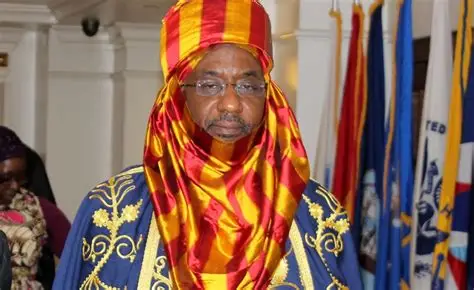
Sanusi Lamido Sanusi, also known as Muhammadu Sanusi II, is a Nigerian economist, banker, Islamic scholar, and traditional ruler widely recognized as one of Africa’s most influential public intellectuals. Best known for serving as Governor of the Central Bank of Nigeria and as the Emir of Kano, Sanusi has shaped national conversations on economic reform, financial stability, education, governance, and social development.
Born into the renowned Fulani royal family of Kano, he has combined distinguished leadership in banking with deep scholarship in Islamic studies and a longstanding commitment to public service. His bold advocacy and reform-oriented approach have established him as one of Nigeria’s most respected traditional and economic leaders.
His career spans high-level banking, academia, and traditional governance. Sanusi has influenced Nigeria’s financial sector through major reforms during a global crisis and later used his platform as emir to address issues like girls’ education, women’s rights, and governance accountability. His life reflects a blend of modern economic thought, Islamic scholarship, and commitment to Kano’s cultural heritage.
This article explores Sanusi Lamido Sanusi’s biography, career, achievements, personal life, and enduring legacy.
Sanusi Lamido Sanusi Early Life
Sanusi Lamido Sanusi was born on July 31, 1961, in Kano, Nigeria. He comes from a ruling-class Fulani family of the Sullubawa clan within the Torobe Fulani group, part of the broader Dabo dynasty that has deep roots in Kano’s history. His state of origin is Kano State, located in northern Nigeria, a region known for its ancient emirate system dating back over a thousand years, vibrant trade, Islamic scholarship, and agricultural economy. Kano has long served as a commercial and cultural hub in West Africa.
His grandfather, Muhammadu Sanusi I, was the 11th Emir of Kano, reigning from 1953 until his deposition in 1963. This royal lineage profoundly shaped Sanusi’s upbringing. His father, Muhammad Aminu Sanusi (also referred to as Muhammad Lamido Sanusi), held the princely title of Chiroma of Kano and built a distinguished career as a diplomat. He served as Nigeria’s ambassador to Belgium, China, and Canada, and later as Permanent Secretary in the Ministry of Foreign Affairs. His mother was Saudatu Hussain (sometimes listed as Saudatu Anduwa Hussain or Saudatu Sanusi). Sanusi grew up in an environment that valued both traditional authority and public service.
As a child, Sanusi received early Quranic education at home, studying the Quran, Hadith, and traditions of the Prophet Muhammad. He attended St. Anne’s Catholic Primary School in Kakuri, Kaduna, from around 1967 to 1972 or 1973, where he obtained his First School Leaving Certificate. This experience in a Catholic school for a Muslim prince highlighted his family’s progressive approach to education. He later moved to the prestigious King’s College in Lagos from 1973 to 1977 for his secondary education, gaining exposure to Nigeria’s diverse cultural landscape.
Growing up near royal palaces, including that of his great-uncle Ado Bayero (who reigned as Emir for over 50 years), Sanusi absorbed lessons in leadership, justice, and authority. These early influences prepared him for roles that would require balancing tradition with reform.
Sanusi Lamido Sanusi Education
Sanusi Lamido Sanusi pursued a strong academic path that combined economics with Islamic studies. After secondary school, he enrolled at Ahmadu Bello University (ABU) in Zaria, earning a Bachelor of Science degree in Economics in 1981. He completed his National Youth Service Corps (NYSC) in Gongola State (now parts of Adamawa and Taraba), teaching at a girls’ boarding school in Yola. He returned to ABU for a Master’s degree in Economics in 1983, focusing on monetary policy and graduating with distinction. He briefly lectured in the Economics department there.
In the early 1990s, Sanusi deepened his Islamic scholarship. He studied at the International University of Africa in Khartoum, Sudan, where he obtained a first-class degree in Sharia and Islamic Studies (with an elective in Arabic) in 1997. There, he became fluent in Arabic and immersed himself in fiqh (Islamic jurisprudence), philosophy (falsafa), the Quran, and the four Sunni madhhabs (Hanafi, Maliki, Shafi’i, and Hanbali). He also engaged with Western thinkers alongside classical Islamic texts.
This dual education equipped him with analytical skills in economics and a profound understanding of Islamic law and ethics. In 2024, he earned a PhD in Islamic Law from the School of Oriental and African Studies (SOAS) at the University of London. His thesis examined the codification of Islamic family law as a tool for social reform, comparing the Emirate of Kano with Morocco.
Sanusi Lamido Sanusi Career
Sanusi Lamido Sanusi built a multifaceted career in academia, banking, and public service before ascending to traditional leadership.
Sanusi Lamido Sanusi Banking Career
Sanusi entered the banking sector in 1985 at ICON Limited, a merchant bank and subsidiary of Barings Bank and Morgan Guaranty Trust. He worked in corporate finance, treasury services, credit, and marketing, rising to Area Manager for the North by 1991. In 1997, after returning from Sudan, he joined United Bank for Africa (UBA) as Principal Manager in Credit Risk Management. He advanced to General Manager by 2005.
In 2005, he moved to First Bank of Nigeria Plc as Executive Director for Risk Management and Control. In January 2009, he became Group Managing Director and CEO of First Bank, the first northerner in that role at Nigeria’s oldest bank. His expertise centered on risk management and financial stability.
Sanusi Lamido Sanusi Central Bank Governor
In June 2009, President Umaru Yar’Adua appointed Sanusi as the 10th Governor of the Central Bank of Nigeria (CBN), a position he held until 2014. He took office amid the global financial crisis. Sanusi implemented bold reforms to stabilize the sector. He audited and bailed out distressed banks with over ₦600 billion in liquidity support, dismissed and prosecuted some CEOs, and promoted mergers and acquisitions for stronger institutions. He also introduced non-interest (Islamic) banking in Nigeria.
Sanusi advocated for macroeconomic stability, financial inclusion, and anti-corruption measures. He publicly criticized fuel subsidies for fostering inefficiency and corruption and clashed with the National Assembly over budgetary issues. In late 2013, he raised concerns in a letter about unremitted oil revenues from the Nigerian National Petroleum Corporation (NNPC), alleging around $20 billion was missing. This led to his suspension by President Goodluck Jonathan in February 2014. He faced investigations but maintained his stance on accountability.
His tenure earned international recognition for navigating the banking crisis effectively.
Sanusi Lamido Sanusi Emir of Kano
On June 8, 2014, Sanusi was selected and crowned as the 14th Emir of Kano (Muhammadu Sanusi II), succeeding his great-uncle Ado Bayero. He became a spiritual leader in the Tijaniyyah Sufi order as well. As emir, he advocated for progressive reforms, including girls’ education, women’s rights, and better governance. He criticized misplaced priorities, such as spending on infrastructure while many children remained out of school.
His outspoken nature led to tensions with state authorities. In 2019–2020, under Governor Abdullahi Ganduje, the Kano Emirate was split into five, reducing the central emir’s influence. Sanusi was dethroned on March 9, 2020, for alleged insubordination and banished. He was replaced by Aminu Ado Bayero. Sanusi challenged the actions legally.
In May 2024, under Governor Abba Kabir Yusuf, the emirates were reunified, and Sanusi was reinstated as Emir. This move sparked legal disputes and political debates, highlighting the intersection of tradition and modern politics in Kano.
Sanusi Lamido Sanusi Writings and Scholarship
Sanusi has authored numerous papers, articles, and presentations on banking, economics, politics, religion, and society. His work often explores Islamic perspectives on contemporary issues, risk management in finance, and social reform through law. He speaks frequently at international forums and maintains an active voice on public policy.
Sanusi Lamido Sanusi Awards
Sanusi Lamido Sanusi received several prestigious awards. He was named Central Bank Governor of the Year globally and for Africa by The Banker magazine in 2010. TIME magazine included him in its 2011 list of the 100 most influential people in the world. He earned the Global Islamic Finance Leadership Award and became a GIFA Laureate in 2015 for promoting Islamic banking. Other honors include the Commander of the Order of the Niger (CON) and multiple recognitions as Man of the Year by various publications.
Sanusi Lamido Sanusi Personal Life
Sanusi Lamido Sanusi is married to multiple wives in accordance with Islamic tradition. His wives include Sadiya Ado Bayero (daughter of the late Emir Ado Bayero), Maryam, Rakiya, and Sa’adatu (sometimes listed as Sa’adatu Mustafa Barkindo). He has thirteen children, including eight daughters and five sons, such as Aminu, Shaheeda, Hafsat (Sadeeqa), Saleeha, Khadija, Adam (Ashraf), Mustapha (Imam), Aisha, Husna, Muhammadu Inuwa, Muhammadu Sanusi, Maryam, and Halimatu Sadiya.
He maintains a life that balances royal duties with family and intellectual pursuits. Sanusi is known for his fluency in several languages, including English, Hausa, and Arabic, and his engagement with both traditional and contemporary ideas.
Sanusi Lamido Sanusi Reforms and Advocacy
As both CBN Governor and Emir, Sanusi pushed for financial sector soundness, Islamic finance integration, and social reforms. He emphasized education for girls, economic empowerment, and accountability in governance. His advocacy often challenged established norms, earning both admiration and criticism.
Sanusi Lamido Sanusi Legacy and Influence
Sanusi’s career demonstrates the potential for traditional institutions to engage with modern challenges. His actions in banking helped stabilize Nigeria’s economy during turmoil, while his tenure as emir highlighted debates over authority, reform, and federal-state dynamics in Nigeria. He remains a influential voice in discussions on northern Nigeria’s development.
Read Also: Ebiere Soberekon Biography: Age, State of Origin, Husband, Wedding Day, Career, Net Worth & Family
Conclusion
Sanusi Lamido Sanusi continues to shape conversations on economics, culture, and leadership in Nigeria. His journey from economist to traditional ruler reflects a dedication to service, reform, and the preservation of heritage amid change.
FAQs
Who is Sanusi Lamido Sanusi?
Sanusi Lamido Sanusi is a Nigerian economist, former Central Bank Governor, and the current Emir of Kano, known as Muhammadu Sanusi II.
When and where was Sanusi Lamido Sanusi born?
He was born on July 31, 1961, in Kano, Nigeria.
What is Sanusi Lamido Sanusi’s educational background?
He holds degrees in Economics from Ahmadu Bello University and Islamic Studies from the International University of Africa, plus a PhD in Islamic Law from SOAS, University of London.
What major reforms did Sanusi Lamido Sanusi implement as CBN Governor?
He led bank bailouts, risk management improvements, the introduction of Islamic banking, and efforts to enhance financial stability and inclusion.
Why was Sanusi Lamido Sanusi dethroned in 2020?
The Kano State government under Governor Ganduje cited insubordination; the move followed the creation of additional emirates and political tensions.
When was Sanusi Lamido Sanusi reinstated as Emir?
He was reinstated on May 23, 2024, following legislative changes by the new state government.
How many children does Sanusi Lamido Sanusi have?
He has thirteen children from his marriages.