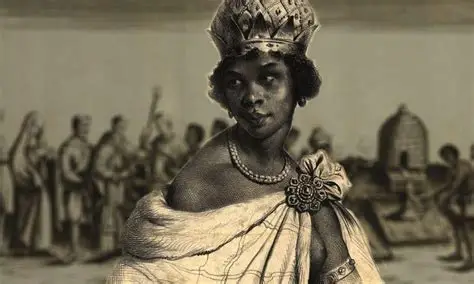
Queen Nzinga Mbande, also known as Njinga Mbandi, Ana de Sousa Nzinga, or Nzinga of Ndongo and Matamba, was a seventeenth-century African queen, military strategist, and diplomat widely regarded as one of the greatest female rulers in African history. Best known for leading the kingdoms of Ndongo and Matamba in present-day Angola, she fiercely resisted Portuguese colonial expansion and fought to protect her people’s sovereignty during the transatlantic slave trade.
Born around 1583, Nzinga combined exceptional political leadership, diplomatic skill, and military strategy to rule for nearly four decades, earning a lasting reputation as a symbol of courage, resistance, and African independence. Her remarkable legacy continues to inspire historians, scholars, and leaders around the world
Queen Nzinga Mbande navigated challenges from European powers while managing internal rivalries and building alliances. She adapted to changing situations, forming partnerships when needed and fighting when necessary. Her leadership preserved independence for her kingdoms longer than many neighboring states. Today, she stands as a symbol of resistance and African sovereignty, honored in Angola as a national heroine and remembered across the African diaspora.
Queen Nzinga Mbande Early Life
Queen Nzinga Mbande was born around 1583 in Kabasa, the capital of the Kingdom of Ndongo, located in present-day northern Angola. Her full name at birth was Nzinga Mbande, and she belonged to the royal family of the Mbundu people. The Kingdom of Ndongo was a significant Mbundu-speaking polity in Central Africa, with its ruler holding the title ngola, from which the modern name Angola derives.
Her father was Ngola Kiluanji kia Samba (also referred to as Mbande a Ngola or similar variations), who became king around 1592 when Nzinga was about ten years old. Her mother was Kengela ka Nkombe (or Kangela, Guenguela Cakombe), a favored concubine of slave origin, which later sparked questions about Nzinga’s legitimacy in some traditional views. According to oral traditions and historical accounts, Nzinga’s birth was difficult. The umbilical cord wrapped around her neck, leading to her name derived from the Kimbundu word kujinga, meaning “to twist” or “to turn.” This event was seen as a sign of a strong, proud, and destined future.
The Kingdom of Ndongo, where Queen Nzinga Mbande grew up, was situated in the highlands east of the Kwanza River. It featured a decentralized political structure with provincial leaders called sobas under the central authority of the ngola. The region was rich in resources but faced increasing external pressures from Portuguese traders and settlers on the coast, who sought slaves, ivory, and control over trade routes. Internal dynamics included rivalries among noble families and the influence of Imbangala warriors, nomadic groups known for their military prowess.
As a child in the royal court, Queen Nzinga Mbande received training unusual for women at the time. She learned statecraft, rhetoric in Kimbundu, diplomacy, and military skills. She accompanied her father to councils and observed interactions with Portuguese envoys. She trained in warfare, including the use of battle axes and martial dances that taught agility and strategy. Her father favored her, fostering her physical and intellectual abilities. This early exposure prepared her for leadership in a volatile environment marked by slave raids and colonial incursions.
The state of origin for Queen Nzinga Mbande was the Kingdom of Ndongo, part of the broader Mbundu cultural and political landscape in Central Africa. Ndongo maintained independence through tribute systems, alliances, and military force before Portuguese expansion intensified in the late 16th and early 17th centuries. The capital Kabasa served as a political and cultural center. Matamba, which she later ruled, lay to the east and had a tradition of female leadership, providing a strategic base. These regions formed the heart of her identity and power base.
Queen Nzinga Mbande’s early years coincided with growing Portuguese influence. The Portuguese had established Luanda in 1575 and pushed inland, disrupting local economies and societies through the slave trade. Her family’s rule involved balancing relations with these outsiders while managing internal threats. This context shaped her pragmatic approach to power.
Queen Nzinga Mbande Education
Queen Nzinga Mbande gained practical education within the royal court of Ndongo rather than through formal institutions. She mastered Kimbundu language, court protocols, and oratory skills essential for leadership and negotiation. Exposure to Portuguese traders and missionaries allowed her to learn Portuguese, a valuable tool for diplomacy. She studied military strategy by training alongside warriors and observing her father’s campaigns.
This hands-on learning included understanding trade networks, alliance-building, and the customs of neighboring peoples. She developed knowledge of geography, resources, and warfare tactics suited to the terrain of Central Africa, such as guerrilla methods in riverine and highland areas. Her education emphasized adaptability, a trait she used throughout her life.
Queen Nzinga Mbande Rise to Prominence
Queen Nzinga Mbande first gained wide attention in 1622 when she served as an emissary for her brother, King Ngola Mbande, in negotiations with the Portuguese governor in Luanda. The Portuguese sought greater control and tribute, while Ndongo aimed to protect its sovereignty. During the meeting, the governor expected her to sit on the floor as a sign of submission. Instead, Queen Nzinga Mbande had one of her attendants kneel, using the attendant’s back as a seat. This bold act symbolized equality and defiance, becoming a legendary moment in her story.
The negotiations resulted in a temporary treaty recognizing Ndongo’s independence and addressing the return of captives. Queen Nzinga Mbande was baptized as Ana de Sousa during this visit, a strategic move to build rapport with the Catholic Portuguese. However, the peace proved fragile as Portuguese forces continued aggressive actions.
Queen Nzinga Mbande Accession to the Throne
Following her brother Ngola Mbande’s death in 1624 under uncertain circumstances, Queen Nzinga Mbande assumed power. Accounts vary, with some suggesting she played a role in his passing or the elimination of rivals, including her nephew. She proclaimed herself queen despite traditional preferences for male rulers and faced opposition from Portuguese-backed claimants like Ngola Hari.
Internal challenges and external threats forced her to flee Ndongo temporarily. She sought refuge in islands along the Kwanza River and allied with groups like the Imbangala warriors, adopting some of their practices to strengthen her forces. By 1631, she conquered the Kingdom of Matamba, which had a history of queens, and made it her primary base. This move provided a defensible position farther from Portuguese strongholds and allowed her to rebuild her power.
Queen Nzinga Mbande Military Leadership and Strategies
Queen Nzinga Mbande excelled as a military commander. She organized mixed-gender armies trained in guerrilla tactics, ambushes, and hit-and-run attacks suited to the African landscape. Her forces harassed Portuguese supply lines, disrupted slave routes, and conducted raids to weaken colonial positions. She led troops personally, even into her later years, demonstrating endurance and tactical skill.
Alliances played a key role. She partnered with the Imbangala for military strength and later with the Dutch, who occupied Luanda in 1641. This alliance helped challenge Portuguese dominance. In battles like the one at Kombi in 1647, her coalition achieved notable successes. She also used Matamba as a sanctuary for escaped slaves and refugees, bolstering her population and loyalty.
Her approach balanced warfare with pragmatism. She participated in the slave trade at times to fund her efforts and acquire weapons, redirecting resources away from the Portuguese. This controversial aspect funded resistance while protecting her core territories.
Queen Nzinga Mbande Diplomatic Efforts
Diplomacy defined much of Queen Nzinga Mbande’s career. Beyond the 1622 mission, she negotiated multiple treaties. She shifted alliances as needed, moving between Portuguese, Dutch, and local powers. Her correspondence with European authorities and missionaries showed political sophistication.
In the 1650s, after years of conflict, she secured a peace treaty in 1656-1657. It recognized her authority over parts of her territories, allowed limited trade, and brought relative stability. She welcomed Capuchin missionaries while maintaining traditional practices, blending influences for political advantage.
Queen Nzinga Mbande State Building and Administration
In Matamba, Queen Nzinga Mbande centralized authority, reorganized trade routes, and built a stable state. She settled Ndongo exiles, integrated diverse groups, and created a professional army. Her capital became a hub connecting regional merchants. Female leadership traditions in Matamba supported her rule, leading to a line of queens after her.
She promoted loyalty through strategic marriages, appointments, and protections for her people. Her administration focused on security, economic resilience, and cultural preservation amid external threats.
Queen Nzinga Mbande Personal Life
Details of Queen Nzinga Mbande’s personal life are limited and often shaped by European accounts. She had no surviving children after early losses, partly due to her brother’s actions. She formed alliances through relationships and maintained a harem of men in some traditions, using personal bonds for political cohesion. She converted to Christianity multiple times for diplomacy but practiced indigenous beliefs.
Her resilience in battle and rule highlighted her strength. She remained active in her seventies, leading parades and governing effectively.
Queen Nzinga Mbande Awards and Recognitions
During her lifetime, formal awards were not common in her context, but she received recognition through treaties and diplomatic honors. The Portuguese and Dutch acknowledged her authority at various points. Posthumously, she has received many honors. In Angola, she is the “Mother of the Nation,” with statues in Luanda, a national holiday observance, and currency features. Modern tributes include books, documentaries like the Netflix series, and academic studies.
Queen Nzinga Mbande Legacy
Queen Nzinga Mbande’s legacy endures as a model of resistance. She prevented full Portuguese conquest during her reign and inspired later generations. Oral traditions spread her story through the African diaspora. In Angola’s independence struggle, she symbolized nationalism. Today, scholars and artists celebrate her as a trailblazing female leader who defied gender norms and colonialism.
Her rule ensured female successors in Matamba for decades. Historians like Linda M. Heywood have detailed her life, highlighting her complexity as warrior, diplomat, and ruler.
Read Also: Ebiere Soberekon Biography: Age, State of Origin, Husband, Wedding Day, Career, Net Worth & Family
Conclusion
Queen Nzinga Mbande lived a life of extraordinary determination. From her origins in Ndongo to her reign over unified kingdoms, she protected her people’s autonomy against formidable odds. Her strategies combined military prowess, diplomatic flexibility, and state-building vision. She remains an inspiring figure in African history, embodying courage and leadership.
FAQs
What was Queen Nzinga Mbande’s full name and birth details?
Queen Nzinga Mbande, also known as Njinga Mbandi or Ana de Sousa, was born around 1583 in Kabasa, Kingdom of Ndongo, in present-day Angola.
How did Queen Nzinga Mbande become queen?
She assumed power after her brother’s death in 1624, overcoming rivals and establishing rule over Ndongo before expanding to Matamba.
What were Queen Nzinga Mbande’s main achievements against the Portuguese?
She used guerrilla warfare, alliances with the Dutch and Imbangala, and strategic treaties to resist colonization and maintain independence for decades.
Did Queen Nzinga Mbande participate in the slave trade?
Yes, she engaged in it strategically to fund her military and divert resources, while offering sanctuary to many escapees.
How is Queen Nzinga Mbande remembered today?
As Angola’s national heroine and a symbol of African resistance, featured in statues, literature, films, and educational materials worldwide.
What was the significance of the 1622 negotiation incident?
It demonstrated her refusal to accept subordination, using an attendant as a seat to assert equality with Portuguese officials.