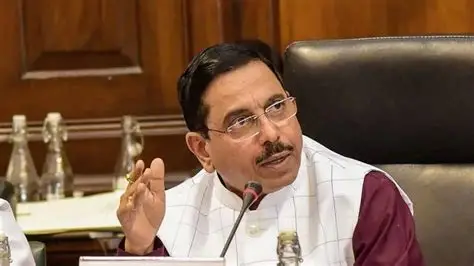
Pralhad Venkatesh Joshi is a veteran Indian politician, senior Bharatiya Janata Party (BJP) leader, and long-serving Member of Parliament from the Dharwad constituency in Karnataka. Since winning his first Lok Sabha election in 2004, he has secured consecutive victories and built a reputation as one of Karnataka’s most influential political figures. Throughout his career, he has led key ministries in the Union Cabinet, strengthened the BJP’s organizational structure, and played a major role in national governance. As a result, his leadership, political experience, and consistent electoral success continue to shape India’s political landscape.
Over more than two decades in national politics he has moved from grassroots activism linked to the Rashtriya Swayamsevak Sangh to the role of a multi portfolio Cabinet minister. In 2024 he assumed charge of Consumer Affairs, Food and Public Distribution together with New and Renewable Energy. In July 2026 he additionally took over the Education portfolio following a change in the ministry. Throughout this journey he has maintained strong ties to North Karnataka while contributing to national policy on energy, parliamentary functioning and public distribution systems.
Pralhad Joshi Early Life
Pralhad Venkatesh Joshi was born on 27 November 1962 in Bijapur, then part of Mysore State and now known as Vijayapura in Karnataka. He is the third child of Venkatesh Joshi and Malatibai Joshi. His father worked as an employee of the Indian Railways, a circumstance that shaped the family’s mobility and the educational choices available to the children. The household followed traditional values common among North Karnataka Brahmin families of that period, emphasising discipline, education and community service.
Growing up in a railway family meant early exposure to the structured environment of railway colonies and schools. Primary schooling took place at the Railway School, where the curriculum and daily routine reflected the practical outlook of a working class service household. Secondary education continued at New English School in Hubballi, a city that would later become central to his political base. These formative years in Hubballi, with its mix of educational institutions, commercial activity and cultural traditions, provided the social setting in which he developed an interest in public affairs.
The atmosphere of the 1970s and early 1980s in North Karnataka was one of gradual economic change and rising political awareness. Railway employment offered relative stability yet also instilled an appreciation for organised effort and national institutions. Family discussions and local community life introduced him to the ideas of the Rashtriya Swayamsevak Sangh at a young age. This early association with the organisation’s emphasis on cultural nationalism and social discipline became a lasting influence. By the time he reached adulthood he had already begun to participate in local activities that combined personal responsibility with collective goals.
His childhood and adolescence therefore combined modest material circumstances with strong cultural grounding. The move from Bijapur to the Hubballi Dharwad region for education placed him in an urbanising environment that was becoming a focal point of political and social movements in Karnataka. These experiences of family duty, school discipline and early organisational contact formed the foundation for his later transition from private enterprise into public life.
Pralhad Joshi Education
After completing secondary studies at New English School in Hubballi, Pralhad Joshi pursued higher education at Shri Kadasiddeshwar Arts College, also known as K.S. Arts College, in Hubballi. The college was affiliated with Karnataka University, Dharwad. He obtained a Bachelor of Arts degree, focusing on subjects that equipped him with a broad understanding of social and political issues.
The choice of an arts programme reflected both practical considerations and personal inclination. In the educational landscape of Karnataka during the early 1980s, arts colleges in Hubballi offered accessible routes for students from service backgrounds to complete undergraduate studies while remaining connected to their local communities. Karnataka University provided the academic framework, and the Hubballi campus environment allowed him to balance studies with emerging interests in public organisation.
His education did not extend to professional or technical degrees, yet the undergraduate years proved formative in other ways. Exposure to student discussions, local debates and the growing presence of voluntary organisations deepened his engagement with civic questions. The combination of formal classroom learning and informal organisational activity prepared him for the practical demands of public work rather than a purely academic career. By the time he graduated he possessed both a recognised degree and a network of contacts that would later support his entry into political organisation.
Pralhad Joshi State of Origin and Cultural Background
Pralhad Joshi hails from Karnataka, specifically the northern region centred on the historic city of Bijapur, now Vijayapura. Vijayapura district occupies an important place in the history of the Deccan. For centuries it served as the capital of the Adil Shahi dynasty, leaving behind a rich architectural and cultural legacy that includes the Gol Gumbaz, the Ibrahim Rauza and numerous mosques, tombs and fortifications. The area has long been a meeting point of Kannada, Marathi and other linguistic and cultural streams of the Deccan plateau.
North Karnataka as a whole is characterised by a distinct social and economic profile. The region experiences a semi arid climate, depends heavily on agriculture and has a tradition of hardy rural communities alongside trading and service groups. Brahmin families in this part of the state traditionally valued education and administrative service, a pattern reflected in the Joshi household through the father’s railway employment. The cultural life of the area includes classical music, local festival traditions and a strong sense of regional identity within the larger Kannada speaking state.
Hubballi Dharwad, where Joshi spent much of his education and early working life, functions as the commercial and educational hub of North Karnataka. The twin cities have historically produced administrators, educators and political figures who bridge local concerns with statewide and national platforms. This setting provided both the practical base and the political opportunity for his later career. Understanding the geography, history and social texture of Vijayapura and the wider North Karnataka region is essential to placing his public life in context. The region’s challenges of development, water resources and industrial growth have remained constant themes in his representation of the Dharwad parliamentary constituency.
Pralhad Joshi Career
Pralhad Joshi began his working life as an industrialist. Private enterprise occupied his early adult years and gave him direct experience of business operations, employment generation and the practical difficulties faced by small and medium enterprises in Karnataka. This phase of life remained connected to Hubballi and the surrounding districts.
Early Political Involvement
While still engaged in business he became active in the Rashtriya Swayamsevak Sangh. The organisation’s network in North Karnataka provided the first structured platform for public work. Between 1992 and 1994 he played a visible role in the movement to hoist the national flag at Idgah Maidan in Hubballi, also known as Kittur Rani Chennamma Maidan. The campaign, conducted under the banner of cultural and nationalist organisations, brought him into wider public notice. During the same period he participated in the Save Kashmir Movement, further establishing his presence among activist circles in the state.
These activities led to organisational responsibilities within the Bharatiya Janata Party. He was elected president of the Dharwad district unit of the party. District level leadership required continuous engagement with local cadres, resolution of organisational issues and preparation for electoral contests. The combination of business background, RSS association and district presidency created a foundation for higher responsibilities.
Parliamentary Career
In the 2004 general election Pralhad Joshi contested the Dharwad Lok Sabha seat and defeated the Indian National Congress candidate. He has held the constituency without interruption through the elections of 2009, 2014, 2019 and 2024, becoming a five term Member of Parliament. Consistent electoral success in a competitive region of Karnataka demonstrated both personal popularity and effective organisation. In 2009 his margin of victory ranked among the higher ones in the state even as several sitting members elsewhere faced defeat.
During his parliamentary terms he served on the Panel of Chairpersons of the Lok Sabha between 2014 and 2018. The role involved presiding over sessions and contributing to the orderly conduct of business. He also held the position of Karnataka state president of the Bharatiya Janata Party from approximately 2012 or 2014 until early 2016. State presidency required coordination of party units across Karnataka, management of internal dynamics and preparation for assembly and local body elections.
Ministerial Roles
On 30 May 2019 Pralhad Joshi was sworn in as a Cabinet minister in the second term of the Narendra Modi government. He was allocated the portfolios of Parliamentary Affairs, Coal and Mines. As Minister of Parliamentary Affairs he played a central role in the legislative process during a period that included the passage of major bills such as the abrogation of Article 370 and the Citizenship Amendment legislation. The coordination of business in both houses of Parliament demanded careful management of timing, consensus building and procedural detail.
In the Coal and Mines ministries he oversaw sectors critical to energy security and industrial raw materials. Reforms aimed at improving production efficiency, transparency in allocation and environmental compliance formed part of the policy agenda during his tenure. These responsibilities continued until the formation of the new government after the 2024 general election.
In June 2024 he was appointed Minister of Consumer Affairs, Food and Public Distribution and Minister of New and Renewable Energy. The dual charge placed him at the intersection of daily consumer welfare, the public distribution system that supplies essential commodities, and the long term transition toward cleaner energy sources. Work in these areas has included attention to food security mechanisms, consumer protection measures and the expansion of renewable capacity under national targets.
In July 2026, following the resignation of the previous Education Minister amid controversy surrounding the National Testing Agency and the NEET examination process, Pralhad Joshi was given additional charge of the Ministry of Education. He continues to hold his existing portfolios while addressing the immediate and structural issues of the education sector. The combination of responsibilities reflects the confidence placed in his administrative experience and parliamentary standing.
Throughout his ministerial career the emphasis has remained on practical implementation, coordination across departments and responsiveness to both national priorities and the developmental needs of his home constituency. Infrastructure projects, educational institutions and energy related initiatives in the Dharwad region have received sustained attention alongside national policy work.
Pralhad Joshi Achievements in Public Life
The most visible measure of Pralhad Joshi’s public standing is his uninterrupted representation of Dharwad since 2004. Five consecutive victories in a parliamentary constituency that has seen shifting political currents indicate consistent voter support and organisational strength. As Karnataka BJP president he contributed to the party’s structural consolidation in the state during a period of significant political competition.
In the Union Cabinet his tenure as Minister of Parliamentary Affairs coincided with the successful passage of several complex and high stakes legislative measures. The ability to manage floor coordination across parties and houses during those years is frequently cited as a practical achievement. In the Coal and Mines ministries the period saw continued focus on production targets, commercialisation of certain operations and regulatory improvements. Subsequent work in Consumer Affairs and Food and Public Distribution has involved oversight of systems that affect millions of households through the public distribution network. The New and Renewable Energy portfolio places him at the centre of India’s efforts to expand solar, wind and other non fossil sources in line with stated national goals.
At the constituency level successive terms have allowed sustained engagement with local development priorities. Road connectivity, educational facilities, urban infrastructure in Hubballi Dharwad and support for agricultural and industrial concerns have remained recurring themes. The recent assumption of the Education portfolio adds another layer of national responsibility at a moment when examination systems and higher education governance face public scrutiny.
Pralhad Joshi Awards and Recognitions
Public records do not highlight a long list of formal civilian awards conferred on Pralhad Joshi. Recognition has primarily taken the form of successive electoral mandates, elevation to Cabinet rank and continued organisational responsibilities within the Bharatiya Janata Party. The trust placed in him by the party leadership and the central government across multiple portfolios itself constitutes a form of institutional recognition. His long parliamentary tenure and the ability to retain a competitive seat over two decades further underscore the practical endorsement he has received from voters and party structures.
Pralhad Joshi Personal Life
Pralhad Joshi married Jyoti Joshi, also referred to as Jyothi Joshi, on 26 November 1992. The couple have three daughters and no sons. The family has largely maintained a private profile, with limited public visibility of the daughters’ personal or professional details beyond occasional references in media coverage of family events. One of the daughters’ weddings was noted in regional reporting from Hubballi.
His personal interests include reading, Indian classical music and cricket. These pursuits provide a balance to the demands of continuous political and ministerial work. The family continues to maintain connections with Hubballi, where a permanent address has been recorded in parliamentary records. Despite the intensity of national responsibilities he has retained a base in the constituency that first elected him and that continues to form the core of his political identity.
Read Also: Ebiere Soberekon Biography: Age, State of Origin, Husband, Wedding Day, Career, Net Worth & Family
Conclusion
Pralhad Venkatesh Joshi’s life traces a clear path from a railway employee’s household in Bijapur through education in Hubballi, early business activity, organisational work with the RSS and the BJP, five successive terms in the Lok Sabha and progressive elevation to multiple Cabinet portfolios. His career illustrates the combination of local rootedness in North Karnataka with sustained engagement at the national level. Whether coordinating parliamentary business, overseeing energy and mining sectors or addressing consumer welfare and renewable energy goals, the emphasis has remained on administrative continuity and organisational discipline. As he takes on the additional responsibility of the Education Ministry in 2026, his experience across different domains of government continues to shape his contribution to public life in India.
FAQs
What is the full name and date of birth of Pralhad Joshi?
His full name is Pralhad Venkatesh Joshi. He was born on 27 November 1962.
Where was Pralhad Joshi born and what is his nationality?
He was born in Bijapur, then in Mysore State and now Vijayapura in Karnataka, India. He is an Indian national.
What is Pralhad Joshi’s educational background?
He completed primary education at the Railway School, secondary education at New English School in Hubballi, and graduated with a Bachelor of Arts from Shri Kadasiddeshwar Arts College in Hubballi, affiliated with Karnataka University, Dharwad.
Which constituency does Pralhad Joshi represent and how many times has he been elected?
He represents the Dharwad Lok Sabha constituency in Karnataka. He has been elected five times, in 2004, 2009, 2014, 2019 and 2024.
What ministerial positions has Pralhad Joshi held?
He served as Union Minister of Parliamentary Affairs, Coal and Mines from 2019 to 2024. Since June 2024 he has held Consumer Affairs, Food and Public Distribution and New and Renewable Energy. In July 2026 he additionally assumed charge of the Ministry of Education.
Is Pralhad Joshi married and does he have children?
Yes, he married Jyoti Joshi on 26 November 1992. The couple have three daughters.
What was Pralhad Joshi’s early political activity?
He participated in the movement to hoist the national flag at Idgah Maidan in Hubballi between 1992 and 1994 and was involved in the Save Kashmir Movement. He later became Dharwad district president of the BJP and Karnataka state president of the party.
What is Pralhad Joshi’s professional background before full time politics?
He worked as an industrialist in his early adult years while also engaging in organisational activities.