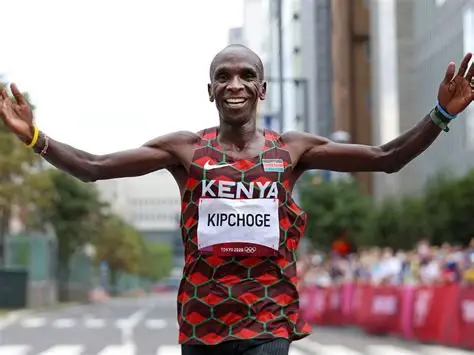
Eliud Kipchoge is a Kenyan long-distance runner widely regarded as the greatest marathon runner in history. Celebrated for his unmatched endurance, disciplined training, and record-breaking performances, Kipchoge has redefined marathon running through consistent excellence on the global stage.
Born in the highlands of western Kenya, he turned exceptional determination and relentless dedication into an extraordinary career, winning two Olympic marathon gold medals, setting multiple world records, and claiming victories in many of the world’s most prestigious marathons. His remarkable achievements continue to inspire athletes and distance runners around the world.
This biography presents a full account of his life, from his early years in Nandi County through his education, professional career, personal life, and lasting impact on athletics. It draws on verified records of his races, public statements, and the cultural background of the place that shaped him. Readers will find a clear picture of the man who once ran a marathon in under two hours and who continues to inspire runners everywhere with his steady focus and quiet determination.
Eliud Kipchoge Early Life
Eliud Kipchoge was born on 5 November 1984 in the small village of Kapsisiywa in what is now Nandi County, Kenya. At the time the area formed part of the larger Rift Valley Province. He is the youngest of four children. His father passed away when Eliud was still a young boy, so he was raised by his mother, a primary school teacher. The family lived a simple life on a small farm where daily chores and long walks were part of ordinary existence.
Kapsisiywa sits in the highlands at an elevation of nearly two thousand metres. The air is thin and cool, the hills roll gently, and the soil supports maize, tea, and livestock. Children in such villages often walk several kilometres to school each day. Young Eliud did the same, covering about three kilometres on foot every morning and evening. Those walks became his first form of training. He did not think of himself as a future champion. He simply moved through the landscape the way most rural Kenyan children do.
The Nandi people, to whom he belongs, form one of the main branches of the Kalenjin community. The Kalenjin are known for producing many of Kenya’s finest distance runners. Life in the highlands builds strong lungs and strong legs from an early age. Eliud grew up hearing stories of local athletes who had travelled far and returned with medals. Yet his own childhood remained modest. He helped on the farm, attended local primary school, and spent free hours playing with friends or helping his mother.
By the time he reached his mid teens he had developed a natural ease with long runs. In 2001, when he was sixteen, he met Patrick Sang, a former Olympic steeplechase medallist who had begun coaching young runners. Sang recognised the quiet determination in the boy and invited him into a more structured training group. That meeting marked the true start of Eliud’s athletic path, though serious competition would come a little later.
Eliud Kipchoge Education
Eliud attended Kaptel Secondary School in Nandi County and completed his secondary education in 1999. School records and later interviews show that he was a regular student rather than a standout academic. Running was not yet the centre of his life. He continued the daily walks to school and joined school sports when required, but he did not train with the intensity that would later define him.
After secondary school he did not proceed immediately to university or college. The demands of training and the opportunities that opened through athletics took priority. In later years he received recognition from higher education institutions. In 2023 Jomo Kenyatta University of Agriculture and Technology awarded him an honorary doctorate in recognition of his achievements and his contribution to sport and national pride. The honour reflected the respect he had earned far beyond the track and the road.
His formal education remained grounded in the Kenyan secondary system of the late 1990s. What he learned outside the classroom, through discipline, routine, and observation of nature, proved equally valuable. He has often spoken of the importance of mental strength and the habit of finishing what one starts. Those lessons began in the classrooms and pathways of Nandi County and continued through every stage of his career.
Eliud Kipchoge Roots in Nandi County
Nandi County lies in the western highlands of Kenya within the broader Rift Valley region. It covers roughly two thousand eight hundred and eighty four square kilometres. The capital is Kapsabet. Other towns include Nandi Hills, Mosoriot, and Kabiyet. The county is shaped like a jug and is bordered by the equator to the south. Most of the land sits at elevations between one thousand eight hundred and two thousand two hundred metres. The Nandi Hills form a striking feature of the landscape, covered in tea plantations and indigenous forest.
The majority of the population belongs to the Nandi people, one of the largest groups within the Kalenjin ethnic community. The Kalenjin also include the Kipsigis, Tugen, Keiyo, Marakwet, and others. Historically the Nandi were known as skilled warriors who resisted British colonial advances in the early twentieth century under leaders such as Koitalel arap Samoei. Their language belongs to the Southern Nilotic family. Traditional life centred on cattle herding, farming, and strong community ties.
The high altitude, cool climate, and rolling terrain create ideal conditions for distance running. Many of Kenya’s greatest athletes come from Nandi and neighbouring counties. Young people grow up walking long distances, herding animals on steep slopes, and breathing thin air that develops efficient oxygen use. Eliud’s village of Kapsisiywa shares these characteristics. The red soil paths, the early morning mist, and the sound of cattle bells form the backdrop of his earliest memories.
In recent decades Nandi County has invested in sports facilities and training camps. Eliud himself has supported projects that give young athletes better opportunities. The county remains proud of its runners and continues to produce new generations of talent. Understanding this setting helps explain why so many world class marathoners emerge from the same hills. The land itself seems to shape the bodies and minds of those who grow up there.
Eliud Kipchoge Career
Eliud’s professional path began on the track before moving to the roads. Under the guidance of Patrick Sang he developed into a world class five thousand metre runner while still a teenager.
Track Success and Early International Races
In 2003, at the age of eighteen, Eliud won the junior race at the World Cross Country Championships. Later that year he claimed the senior five thousand metre title at the World Championships in Paris, outsprinting the great Hicham El Guerrouj by a fraction of a second. The same season he set a world junior record of twelve minutes fifty two point six one seconds for five thousand metres.
At the 2004 Athens Olympics he earned bronze in the five thousand metres behind El Guerrouj and Kenenisa Bekele. Four years later in Beijing he took silver, again behind Bekele. He also collected silver at the 2007 World Championships and bronze at the 2006 World Indoor Championships over three thousand metres. These results established him as one of Kenya’s leading track athletes.
Transition to Road Running
After missing selection for the 2012 Olympic team, Eliud turned his attention to longer distances. His half marathon debut produced a time of fifty nine minutes twenty five seconds, one of the fastest first attempts ever recorded. In April 2013 he won the Hamburg Marathon in two hours five minutes thirty seconds, setting a course record. Later that year he finished second at the Berlin Marathon behind Wilson Kipsang, who broke the world record. The performance showed that Eliud belonged among the elite of the marathon.
Major Marathon Victories
From 2014 onward Eliud built an extraordinary record in the World Marathon Majors. He won the Chicago Marathon in 2014. He then claimed four victories in London (2015, 2016, 2018, 2019) and five in Berlin (2015, 2017, 2018, 2022, 2023). He also won the Tokyo Marathon in 2022.
Between 2014 and 2019 he won every marathon he entered, a streak of ten consecutive victories. His only losses in the early part of his marathon career were the second place in Berlin 2013, an eighth place in London 2020 caused by an ear problem, and later results after 2023.
Olympic Marathon Glory
At the 2016 Rio Olympics Eliud won the marathon gold medal in two hours eight minutes forty four seconds. Five years later, at the Tokyo Games held in 2021, he defended the title in two hours eight minutes thirty eight seconds. He became only the third man in history to win consecutive Olympic marathon gold medals. At the 2024 Paris Olympics he started the race aiming for a third consecutive title but withdrew around the thirty one kilometre mark because of back pain. After the race he indicated that his Olympic career had reached its end.
World Records and the Sub Two Hour Barrier
In September 2018 at the Berlin Marathon Eliud set a world record of two hours one minute thirty nine seconds, improving the previous mark by one minute eighteen seconds. In September 2022, again in Berlin, he lowered his own record to two hours one minute nine seconds. That mark stood until Kelvin Kiptum broke it in Chicago the following year.
On 12 October 2019 Eliud took part in the special Ineos 1:59 Challenge in Vienna. Running with rotating pacemakers and on a specially designed course, he finished in one hour fifty nine minutes forty point two seconds. Although the time was not recognised as an official world record because the event did not meet competition rules, it proved that a sub two hour marathon was possible for a human being. Eliud became the first person in recorded history to achieve that mark.
Later Career and Continuing Presence
After 2023 Eliud faced stronger competition and occasional setbacks. He finished outside the top positions in several races yet continued to train at the high altitude camp in Kaptagat. In late 2025 he spoke publicly about evolving rather than retiring, expressing interest in running marathons on all seven continents, including Antarctica, as part of a project to fund libraries across Kenya. His career now spans more than two decades and includes fifteen marathon victories in the early phase of his road career.
Eliud Kipchoge Achievements and Records
Eliud’s list of major titles includes two Olympic marathon gold medals, one Olympic five thousand metre silver, one Olympic five thousand metre bronze, one World Championship five thousand metre gold, one World Championship five thousand metre silver, and one World Cross Country junior gold. On the roads he has won eleven World Marathon Majors titles and holds the record for most Berlin Marathon victories with five. His personal best of two hours one minute nine seconds remains the second fastest marathon time in history. The unofficial sub two hour run in Vienna stands as a landmark moment in the sport. He has also set course records in London, Tokyo, and Hamburg.
Eliud Kipchoge Awards
In October 2019 Kenyan President Uhuru Kenyatta appointed Eliud an Elder of the Order of the Golden Heart in recognition of the sub two hour marathon. The same year he was named BBC World Sport Star of the Year. In 2023 he received the Princess of Asturias Award for Sports from Spain, one of Europe’s most prestigious honours. These awards sit alongside his many athletic medals and reflect both sporting excellence and the wider inspiration he provides.
Eliud Kipchoge Personal Life
Eliud is married to Grace Sugut. The couple have three children and make their family home in Eldoret, a major town in the Rift Valley. Eliud himself lives and trains most of the year at the camp in Kaptagat, about thirty kilometres from Eldoret. The camp follows a simple routine of early morning runs, shared meals, rest, and evening sessions. He is a devout Catholic and often speaks of faith as a source of strength.
He maintains a private personal life and rarely seeks publicity outside his races. When asked about hobbies he points to time spent with his family and the quiet satisfaction of a well executed training day. After the death of fellow Kenyan runner Kelvin Kiptum in 2024, Eliud and his family faced unfounded online accusations that caused distress and briefly affected his training. He has continued to speak about the need for better support systems for athletes after their competitive years.
Eliud Kipchoge Training Philosophy and Daily Life
Eliud is often called the Philosopher because of the thoughtful way he approaches both running and life. He stresses discipline, consistency, and the belief that no human is limited. His training group lives simply: early rising, long runs on dirt roads, strength work, and careful recovery. He trains at altitude year round and places equal value on mental preparation. Many younger runners join the camp hoping to absorb the same habits. Eliud has said that success comes from doing the ordinary things extraordinarily well every single day.
Eliud Kipchoge Influence on Distance Running
Eliud’s career has raised the standard for marathon performance. His world records and the Vienna run pushed the entire sport forward. Young athletes in Kenya and beyond study his races and quote his words. He has shown that sustained excellence over many years is possible when talent meets rigorous preparation. Beyond competition he has spoken about education, community development, and the importance of giving back. His planned library project across Kenya is one example of that wider vision.
Read Also: Ebiere Soberekon Biography: Age, State of Origin, Husband, Wedding Day, Career, Net Worth & Family
Conclusion
Eliud Kipchoge’s journey from the hills of Nandi County to the top of the Olympic podium and the pages of record books is a story of quiet persistence. He began as a boy walking to school and became a man who redefined what the human body can achieve over twenty six miles. Through Olympic gold, world records, and an unofficial barrier broken, he has left a permanent mark on athletics. His example continues to guide new generations of runners who train on the same highland paths and dream of similar heights.
FAQs
What is Eliud Kipchoge’s full name and nationality?
Eliud Kipchoge is a Kenyan long distance runner. He was born in Kapsisiywa, Nandi County, Kenya.
When and where was Eliud Kipchoge born?
He was born on 5 November 1984 in Kapsisiywa, Nandi County, Kenya.
How many Olympic gold medals has Eliud Kipchoge won?
He has won two Olympic gold medals, both in the marathon, at the 2016 Rio Games and the 2020 Tokyo Games.
Did Eliud Kipchoge run a marathon in under two hours?
Yes. On 12 October 2019 in Vienna he finished in one hour fifty nine minutes forty point two seconds during the special Ineos 1:59 Challenge. The time was not an official world record because the event did not follow standard competition rules.
Who is Eliud Kipchoge’s coach?
His long time coach is Patrick Sang, a former Olympic steeplechase medallist who began working with him in 2001.
Where does Eliud Kipchoge train?
He trains at a high altitude camp in Kaptagat, near Eldoret in Kenya’s Rift Valley.
Is Eliud Kipchoge married?
Yes. He is married to Grace Sugut and they have three children.
What is Eliud Kipchoge’s marathon personal best?
His official personal best is two hours one minute nine seconds, set at the 2022 Berlin Marathon.