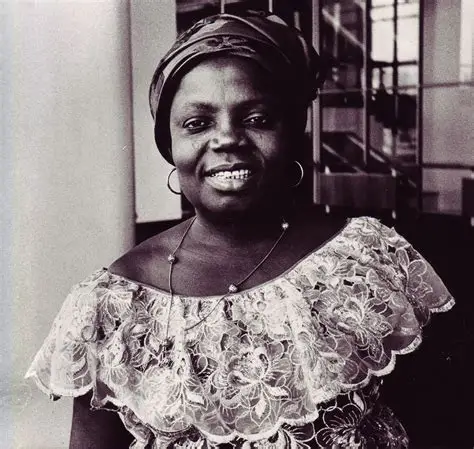
Florence Onyebuchi Emecheta, widely known as Buchi Emecheta, was a Nigerian novelist, autobiographer, playwright, and children’s author celebrated as one of Africa’s most influential literary voices. Best known for acclaimed works such as The Joys of Motherhood, Second-Class Citizen, and The Bride Price, Emecheta explored themes of womanhood, motherhood, migration, education, identity, and resilience through powerful storytelling.
Born in Lagos, Nigeria, she built an internationally respected literary career that gave voice to the experiences of African women and immigrant communities in both Nigeria and Britain. Her groundbreaking contributions to African literature and feminist thought continue to inspire readers, writers, and scholars around the world. This article explores Buchi Emecheta’s biography, literary career, major works, achievements, personal life, and enduring legacy.
Based in London, she drew directly from her life to explore themes of motherhood, gender roles, cultural clashes, education, and resilience. Her stories often highlighted the struggles of single mothers, the impact of tradition on women’s lives, and the realities of racism and poverty in a new country. Over her career, she published more than 20 books and became a pioneering voice in Black British and African literature.
Buchi Emecheta Early Life
Florence Onyebuchi Emecheta was born on 21 July 1944 in Lagos, Lagos State, Nigeria. Her parents, Jeremy Nwabudike Emecheta and Alice Ogbanje Okwuekwuhe Emecheta, were Igbo people of Anioma descent from Umuezeokolo Odeanta village in Ibusa (also known as Ibuza), Delta State.
Her father worked as a railway moulder and was conscripted during World War II. He died when Buchi was nine from complications of a wound sustained while fighting in Burma. Her mother passed away a short time later, leaving Buchi an orphan at a young age.
Buchi Emecheta grew up in a culture where boys often received priority for education. Despite this, she attended missionary schools and won a scholarship to Methodist Girls’ School in Yaba, Lagos, where she studied until she was 16. Books and storytelling became her escape and inspiration. An older aunt who told stories to the children after dinner sparked her early interest in narrative.
Her family ties to Ibusa remained strong. Although she spent much of her childhood in Lagos, visits to the village and stories from her mother about Igbo life deeply influenced her writing. She later set several novels in or around Ibusa, recreating the rhythms of village life, traditions, and the changes brought by colonialism and modernity.
Delta State, her state of origin, is in Nigeria’s South-South region, known for its rich Igbo cultural heritage in the Anioma area, the Niger Delta’s oil resources, and a blend of traditional and modern influences. Ibusa itself is a historic town with deep roots in Igbo customs, including strong community bonds, respect for elders, and gender-specific roles that Buchi Emecheta would later examine critically in her fiction.
Buchi Emecheta Education
Buchi Emecheta received her early education at local missionary schools in Lagos, including Ladilak School and Reagan Memorial Baptist School. Her scholarship to Methodist Girls’ School provided a structured environment where she excelled despite personal losses.
In 1962, she moved to London to join her husband. Life there was difficult, but she pursued higher education while raising children and working. From 1970 to 1974, she studied sociology at the University of London and earned a B.Sc. (Hons) degree. She later completed a PhD from the same university in 1991.
Her education was not just academic. She learned through lived experience, library work, community roles, and constant reading. These paths informed her understanding of sociology, which shaped the social realism in her novels.
Buchi Emecheta Career
Buchi Emecheta’s writing career began in challenging circumstances. She kept diaries about her daily life in London and sent episodes to the New Statesman magazine. Editor Richard Crossman published them as a regular column. These pieces formed the basis of her first book.
Early Writing and Breakthrough Works
Her debut book, In the Ditch (1972), is a semi-autobiographical novel about a single mother named Adah living in a housing estate while supporting her children. It drew from Emecheta’s own struggles with poverty and welfare in London.
Second Class Citizen (1974) followed and became one of her most famous works. It continues Adah’s story, detailing her migration from Nigeria to Britain, her unhappy marriage, and her determination to write despite obstacles. The book explores racism, sexism, and the immigrant experience with honesty and detail.
Historical and Cultural Novels
Buchi Emecheta wrote several novels rooted in Igbo history and village life. The Bride Price (1976) examines marriage customs and a young girl’s fate in a changing society. She had to rewrite it after her husband burned the first manuscript.
The Slave Girl (1977) tells the story of a girl sold into domestic servitude, reflecting her mother’s experiences. It won the Jock Campbell Award from the New Statesman.
The Joys of Motherhood (1979) is often considered her masterpiece. It follows Nnu Ego, a woman who sacrifices everything for her children only to face loneliness and cultural shifts in colonial and post-colonial Nigeria. The novel critiques both traditional Igbo expectations and the failures of modernity for women. It was later listed among Africa’s 100 Best Books of the 20th Century.
Later Novels and Diverse Themes
Her subsequent works expanded into new areas. Destination Biafra (1982) addresses the Nigerian Civil War. Double Yoke (1982) and The Rape of Shavi (1983) tackle gender dynamics and cultural encounters.
Books like Gwendolen (1989, also known as The Family), Kehinde (1994), and The New Tribe (2000) focus on immigrant life in Britain, identity, and belonging. She also wrote children’s books such as Titch the Cat (1979) and Nowhere to Play (1980).
Emecheta worked with publishers like Allison and Busby, where Margaret Busby served as her editor. She briefly ran her own publishing company, Ogwugwu Afor, with her son in the early 1980s.
Academic and Professional Roles
Beyond writing, Buchi Emecheta held various jobs. She worked as a library officer at the British Museum (1965–1969), a youth worker and sociologist for the Inner London Education Authority (1969–1976), and a community worker in Camden.
She served as a visiting professor and lecturer at universities in the United States and Nigeria, including the University of Calabar. She became a Fellow at the University of London in 1986 and engaged with organizations like the Africa Centre.
Buchi Emecheta Writing Style and Themes
Buchi Emecheta’s style is straightforward, realistic, and deeply personal. She used simple, clear prose to make complex social issues accessible. Her narratives often blend autobiography with fiction, allowing readers to feel the emotional weight of her characters’ lives.
Central themes include the burdens and joys of motherhood, the limitations placed on women by custom and colonialism, the search for independence through education, and the tensions between African traditions and Western influences. She portrayed both the strength of Igbo culture and its restrictive aspects, particularly for girls and women.
Her work bridges African and British literary traditions and gives voice to Black women’s experiences in the diaspora.
Buchi Emecheta Awards
Buchi Emecheta received several honors during her lifetime.
- Jock Campbell Prize (New Statesman) in 1978 for The Slave Girl.
- Selected as one of Granta magazine’s Best of Young British Novelists in 1983.
- Officer of the Order of the British Empire (OBE) in 2005 for services to literature.
- Honorary Doctorate of Literature from Fairleigh Dickinson University in 1992.
- Recognition in the British Library’s “A Great Day in London” photograph in 2004, featuring key Black and Asian writers.
Her books continue to receive posthumous attention, with reissues as Penguin Modern Classics.
Buchi Emecheta Personal Life
Buchi Emecheta married Sylvester Onwordi in 1960 at age 16. They had been betrothed since she was 11. The couple had five children: two sons and three daughters. She joined him in London in 1962 with their first two children.
The marriage was difficult and sometimes violent. At 22, while pregnant with her fifth child, she left her husband. She raised the children mostly alone, facing poverty, racism, and the demands of single parenthood. Her husband once burned her manuscript, an event she recounted in her writing.
In her autobiography Head Above Water (1984), she reflected on these years with resilience, describing her survival as a miracle. Two of her daughters predeceased her. She suffered a stroke in 2010 that affected her later years.
Buchi Emecheta Legacy
Buchi Emecheta died on 25 January 2017 in London at age 72. Her son Sylvester Onwordi established the Buchi Emecheta Foundation to promote literary and educational projects in the UK and Africa.
She is remembered as a trailblazer who opened doors for Black women writers. Google honored her with a Doodle on what would have been her 75th birthday in 2019. Spaces and exhibitions continue to celebrate her contributions, and her works remain studied in schools and universities worldwide.
Buchi Emecheta Major Works
Buchi Emecheta authored over 20 books. Key novels include:
- In the Ditch (1972)
- Second Class Citizen (1974)
- The Bride Price (1976)
- The Slave Girl (1977)
- The Joys of Motherhood (1979)
- Destination Biafra (1982)
- The New Tribe (2000)
She also produced plays, children’s books, and her autobiography.
Read Also: Ebiere Soberekon Biography: Age, State of Origin, Husband, Wedding Day, Career, Net Worth & Family
Conclusion
Buchi Emecheta’s life and work demonstrate the power of storytelling to confront hardship and inspire change. From the streets of Lagos and the villages of Ibusa to the challenges of London, she turned personal pain into universal truths about womanhood, migration, and dignity. Her clear voice continues to resonate with readers seeking understanding across cultures.
FAQs
Who was Buchi Emecheta?
Buchi Emecheta was a Nigerian-born British writer known for novels that explore women’s lives, immigration, and cultural identity.
What is Buchi Emecheta’s most famous book?
The Joys of Motherhood is widely regarded as her most acclaimed work, though Second Class Citizen is also very popular.
Where was Buchi Emecheta from?
She was born in Lagos but her family originated from Ibusa in Delta State, Nigeria.
Did Buchi Emecheta win any major awards?
Yes, she received the Jock Campbell Prize, an OBE, and other honors for her literary contributions.
How many children did Buchi Emecheta have?
She had five children.
When did Buchi Emecheta die?
She died on 25 January 2017 in London.