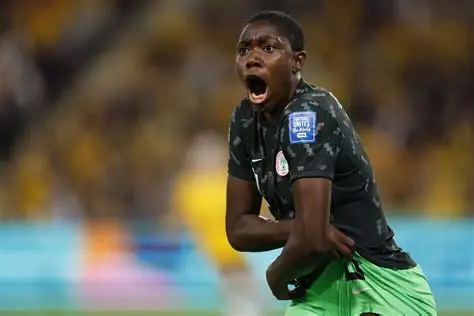
Asisat Lamina Oshoala, popularly known as Asisat Oshoala, is a Nigerian professional footballer widely regarded as one of Africa’s greatest female football players. Celebrated for her exceptional goal-scoring ability, technical brilliance, and consistent success, Oshoala has broken barriers for African women in football while earning global recognition.
Born in Lagos, Nigeria, she built an outstanding career through remarkable performances for leading clubs in Europe, Asia, and the Middle East, while becoming a cornerstone of the Nigeria women’s national team. Her numerous league titles, individual awards, and record-breaking achievements have inspired a new generation of female footballers across Africa. This article explores Asisat Oshoala’s biography, football career, achievements, personal life, and lasting legacy.
This biography explores her life in full, from her beginnings in Ikorodu to her achievements with clubs and the Nigerian national team. It covers her education, professional path, awards, personal life, and ongoing work off the pitch. Readers will find a clear account of how she rose to become a six-time African Women’s Footballer of the Year and a role model for young athletes.
Asisat Oshoala Early Life
Asisat Lamina Oshoala was born on 9 October 1994 in Ikorodu, a bustling town in Lagos State, Nigeria. Lagos State is Nigeria’s commercial and cultural hub, located in the southwestern part of the country along the Atlantic coast. Ikorodu itself sits in the northeastern part of Lagos State, bordering Ogun State and lying along the Lagos Lagoon.
The area is known for its mix of urban energy and traditional Yoruba culture, with markets, waterways, and a strong sense of community that shapes daily life for many residents. Oshoala hails from the Yoruba ethnic group, one of Nigeria’s largest, and grew up speaking Yoruba alongside English and Nigerian Pidgin.
Her family background was modest. Her parents, Iya Asisa and Alhaji Oshoala, worked as shopkeepers. The household was polygamous, with her father having two wives. She has seven siblings in total, two from her mother and others from her father’s other wife. Life in Ikorodu involved the ordinary rhythms of a working-class Nigerian family.
Football was not initially encouraged. Oshoala has spoken about how her parents preferred she focus on studies rather than sport. Despite this, she spent hours after school playing on the streets of Lagos with friends, often returning home with bruises and skinned knees. The joy of the game outweighed any disapproval she faced at home.
As a child she did not imagine a professional career in women’s football, partly because the pathway for girls was limited at the time. Yet her natural talent stood out early. She joined local teams and began to attract attention through informal matches and small tournaments.
The environment of Lagos State, with its dense population and competitive spirit, provided both challenges and opportunities. Girls who played football often faced social pressure, but Oshoala’s persistence set her apart. She later described how the love of the ball kept her going even when support was scarce. This early determination formed the foundation for everything that followed.
Asisat Oshoala Education
Oshoala began her formal education at Air Force Primary School in Victoria Island, Lagos. Victoria Island is one of the more developed parts of the city, known for its schools, businesses, and coastal location. She completed her secondary education at Aunty Ayo International School in Ikoyi, another well-known area of Lagos. These schools offered a standard Nigerian curriculum, and she performed well enough academically while balancing her growing interest in football.
At a certain point she made a difficult choice. She left school to focus fully on football. Her parents did not support this decision, and the tension within the family was real. Oshoala has reflected that education remains important, yet sport offered her a different route to success and independence.
The decision required courage, especially as a young girl in a society where formal schooling was often seen as the safer path. Over time, her achievements on the pitch validated the risk she took. She has since used her platform to encourage other girls to pursue both education and sport where possible, showing that the two need not always conflict.
Asisat Oshoala State of Origin and Roots
Lagos State holds a special place in Oshoala’s story. As Nigeria’s smallest state by land area yet one of its most populous and economically powerful, Lagos is a melting pot of cultures, languages, and ambitions. Ikorodu, her hometown, has grown from a traditional lagoon settlement into a significant suburban center.
Residents often travel into mainland Lagos for work or education, and the area retains strong Yoruba traditions alongside modern influences. The Yoruba people of southwestern Nigeria are known for their rich history of kingdoms, trade, art, and community values. Oshoala’s upbringing reflected these roots. Family, respect for elders, and resilience in the face of hardship were part of daily life.
Growing up near the lagoon and in a commercial city meant exposure to both opportunity and competition. Football is popular across Nigeria, but for girls the path was narrower. Local clubs and school teams offered limited structures compared with boys’ football. Oshoala’s early experiences in Ikorodu and wider Lagos taught her to fight for space on the pitch and to ignore those who said the game was not for her. This background later fueled her desire to create better opportunities for the next generation of Nigerian girls through her foundation and academy.
Asisat Oshoala Career
Oshoala’s professional career began in Nigeria before taking her across continents. Every stage added new skills, trophies, and historic landmarks.
Early Club Days in Nigeria
She started with FC Robo in Mushin, Lagos, a club that developed many young talents. From 2009 to 2013 she progressed through the youth ranks and into senior football. In 2013 she moved to Rivers Angels, one of Nigeria’s strongest women’s teams. With Rivers Angels she scored regularly and gained the confidence needed for the next step. These years in the Nigerian domestic league sharpened her finishing, pace, and physical strength. Coaches noticed her ability to score from distance or in tight spaces, qualities that would later define her at higher levels.
Liverpool and the Move to England
In January 2015 Oshoala signed for Liverpool in the English Women’s Super League. She became the first African player to compete in that competition. At just 20 years old she faced a new climate, different training methods, and higher tactical demands. Despite missing part of the season with a knee injury, she scored three goals in nine appearances. Her first goal came in a 2-1 win over Birmingham City. The move proved that African talent could succeed in Europe’s top leagues and opened doors for others who followed.
Arsenal
In March 2016 she joined Arsenal. That same year she helped the club win the FA Women’s Cup, Arsenal’s 14th title in the competition. She made 13 league appearances and scored two goals as the team finished third. The experience at Arsenal further refined her understanding of European football and its intensity.
Dalian Quanjian in China
In February 2017 Oshoala signed for Dalian Quanjian in the Chinese Women’s Super League. The move brought financial reward and consistent playing time. In her first season she scored 12 league goals and earned the Golden Boot. She also scored four goals in the Women’s Super Cup final as Dalian defeated Shanghai 5-3. The club won the league title that year and repeated the feat in 2018. Across her time in China she scored 23 goals in 20 league appearances, proving her clinical edge in a new environment.
Barcelona
In January 2019 Barcelona signed Oshoala on loan. She scored seven goals in seven appearances and helped the team reach the UEFA Women’s Champions League final. In that final she scored Barcelona’s only goal against Lyon, becoming the first African player to score in a Champions League final. The club made the transfer permanent and extended her contract. Over the following seasons she became a key part of one of the strongest sides in women’s football.
With Barcelona she won multiple Liga F titles, the Copa de la Reina, and the Supercopa de España Femenina. In May 2021 she became the first African woman to win the UEFA Women’s Champions League as Barcelona defeated Chelsea 4-0. She later helped the team win the competition again. In the 2021-22 season she claimed the Pichichi Trophy as the league’s top scorer, another first for an African woman. By the time she left in early 2024 she had scored more than 100 goals for the club and won a long list of domestic and European trophies, including a quadruple in one of her final seasons.
Bay FC
In February 2024 Oshoala joined Bay FC, an expansion side in the National Women’s Soccer League in the United States. She scored the first goal in club history during a 1-0 win over Angel City. Across two seasons she contributed goals and experience to a young squad, finishing as one of the team’s leading scorers in its inaugural year.
Al Hilal
In September 2025 she signed a two-year deal with Al Hilal in the Saudi Women’s Premier League. She scored on her debut and continued her prolific form, registering multiple hat-tricks in cup competitions and finishing the season with a strong goal tally. The move continued her pattern of succeeding in new leagues and cultures.
International Career with Nigeria
Oshoala has represented Nigeria at youth and senior levels with distinction. She starred at the 2014 FIFA U-20 Women’s World Cup, finishing as top scorer with seven goals and earning the best player award. That same year she helped the Super Falcons win the African Women’s Championship, where she was named best player. She has since won the continental title multiple times, including in 2016, 2018, and 2024.
At the FIFA Women’s World Cup she has scored in three consecutive tournaments: 2015, 2019, and 2023. In 2019 she scored against South Korea and was named player of the match. In 2023 her goal against Australia made her the first African player to score in three different World Cups and the first Nigerian to achieve the same. She has also featured at the Olympics and continues to serve as a leader within the national team setup.
Her style of play combines explosive pace, strength, aerial ability, and clinical finishing. She can operate as a central striker or wide forward and has earned nicknames such as “Àgba Baller” and “Superzee” among Nigerian fans.
Asisat Oshoala Awards
Oshoala’s individual honors place her among the elite of the women’s game. She has won the African Women’s Footballer of the Year award a record six times, in 2014, 2016, 2017, 2019, 2022, and 2023. No other player, male or female, has matched this tally. In 2015 she received the BBC Women’s Footballer of the Year award.
In September 2014 President Goodluck Jonathan made her a Member of the Order of the Niger. She later received the higher Officer of the Order of the Niger recognition. In 2021 she was named to the Forbes 30 Under 30 list. She has also been nominated for the Ballon d’Or Féminin and has collected numerous club and tournament awards, including the Pichichi Trophy and Golden Boot honors in different leagues.
Asisat Oshoala Personal Life
Oshoala keeps much of her private life away from the public eye. She is a Muslim and has spoken about the role of faith in her journey. She is currently single and focuses primarily on her career and community work. She is a mother and maintains privacy around her child and the child’s other parent. Family remains important to her, and she has spoken of the support she eventually received from relatives once her success became clear.
Off the pitch she is a Nike brand ambassador. In 2019 she launched the Asisat Oshoala Foundation to empower young female footballers across Africa. The foundation runs programs that combine football training with education, leadership skills, and health awareness. It hosts an annual Football4girls tournament in Lagos.
Building on this work, she later established the Asisat Oshoala Academy in partnership with Nike and other organizations. The academy provides access to football, digital skills, and life training for marginalized schoolgirls in Lagos. Thousands of girls have benefited from these initiatives. Oshoala has also served on FIFA’s technical advisory group focused on the growth of women’s football.
Asisat Oshoala Style of Play and Impact
Oshoala’s game is built on speed, power, and composure in front of goal. She times runs behind defenses well and finishes with either foot or her head. Coaches value her ability to stretch defenses and create space for teammates. Beyond statistics, her presence has inspired a generation of African girls.
By succeeding in England, China, Spain, the United States, and Saudi Arabia, she has shown that talent from the continent can thrive anywhere. Her social media following grew rapidly after strong World Cup performances, making her one of the most visible African female athletes.
Asisat Oshoala Legacy and Influence
Oshoala’s career has helped change perceptions of women’s football in Nigeria and across Africa. She has broken barriers as the first African in the Women’s Super League, the first African woman to score in and win a Champions League final, and the first African woman to claim a European Golden Boot. Her foundation and academy ensure that her impact continues beyond her playing days. Young players now see a clear path that earlier generations lacked. Media coverage, sponsorship, and investment in the women’s game have grown partly because of trailblazers like her.
Read Also: Ebiere Soberekon Biography: Age, State of Origin, Husband, Wedding Day, Career, Net Worth & Family
Conclusion
Asisat Lamina Oshoala’s story is one of talent meeting opportunity and persistence overcoming doubt. From the streets of Ikorodu in Lagos State to the biggest stages in world football, she has written a remarkable chapter in the history of the women’s game. Her six African Player of the Year awards, continental titles, European trophies, and community work form a complete picture of an athlete who has given much and continues to give more. As she plays on with Al Hilal and the Super Falcons, her influence remains strong. Future generations of Nigerian and African footballers will walk paths she helped clear.
FAQs
What is Asisat Oshoala’s full name and date of birth?
Her full name is Asisat Lamina Oshoala. She was born on 9 October 1994.
Where was Asisat Oshoala born and what is her nationality?
She was born in Ikorodu, Lagos State, Nigeria, and is Nigerian by nationality.
Which clubs has Asisat Oshoala played for?
She has played for FC Robo, Rivers Angels, Liverpool, Arsenal, Dalian Quanjian, Barcelona, Bay FC, and Al Hilal.
How many times has Asisat Oshoala won African Women’s Footballer of the Year?
She has won the award a record six times.
Does Asisat Oshoala have a foundation?
Yes, she founded the Asisat Oshoala Foundation and later the Asisat Oshoala Academy to support young girls through football and education.
What is Asisat Oshoala’s playing position?
She plays as a forward or striker.
Has Asisat Oshoala won the UEFA Women’s Champions League?
Yes, she has won it multiple times with Barcelona and was the first African woman to do so.
Is Asisat Oshoala married?
She is currently single and keeps her personal relationships private.
What awards has Asisat Oshoala received from the Nigerian government?
She has been recognized as a Member of the Order of the Niger and later as an Officer of the Order of the Niger.
Why is Asisat Oshoala important to African women’s football?
She has broken multiple records, inspired young players, and used her platform to create opportunities for girls through her foundation and academy.