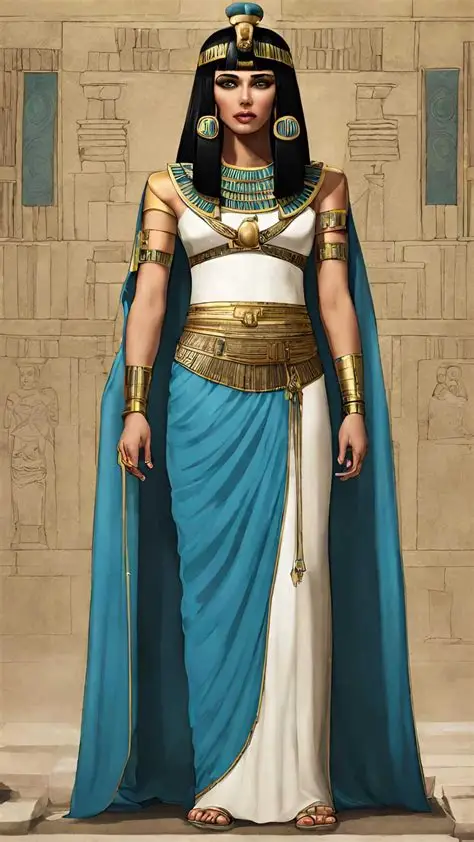
Cleopatra VII Thea Philopator was the last active ruler of the Ptolemaic Kingdom of Egypt and one of the most influential queens in ancient history. Best known for her political brilliance, diplomatic skill, and alliances with Julius Caesar and Mark Antony, Cleopatra ruled Egypt during a pivotal era that ended with the rise of the Roman Empire.
Born in 69 BC in Alexandria to the Macedonian Greek Ptolemaic dynasty, she combined exceptional intelligence, multilingual ability, and strategic leadership to defend Egypt’s independence amid intense political upheaval. Her extraordinary life and dramatic reign have inspired centuries of historical scholarship, literature, and popular culture.
Cleopatra combined intelligence, political skill, and a deep understanding of Egyptian and Greek traditions. She navigated complex alliances with Rome while working to preserve her kingdom’s independence and expand its influence. Her life blended royal duty, strategic partnerships, and personal ambition, leaving a lasting mark on history despite the challenges of her era.
Cleopatra VII Early Life
Cleopatra VII was born in 69 BC in Alexandria, the vibrant capital of the Ptolemaic Kingdom of Egypt. Her father was Ptolemy XII Auletes, often called the Flute Player because of his love for music. Her mother is not known with certainty. Some sources suggest she was Cleopatra V Tryphaena, who was likely her father’s sister or close relative, while others propose an Egyptian noblewoman or another wife.
The Ptolemaic dynasty began after Alexander the Great’s conquests. One of his generals, Ptolemy I Soter, took control of Egypt in 305 BC and established a line of rulers who spoke Greek and maintained strong ties to Hellenistic culture. Cleopatra belonged to this Macedonian Greek family, but she embraced Egyptian customs more than many of her ancestors. Alexandria served as her home, a cosmopolitan city famous for its great library, lighthouse, and role as a center of learning and trade.
Cleopatra grew up in the royal palace amid political instability. Her father faced financial troubles, heavy debts to Rome, and internal opposition. In 58 BC, Ptolemy XII went into exile, and one of Cleopatra’s older sisters, Berenice IV, briefly took the throne. Ptolemy returned in 55 BC with Roman military help, which included the young Mark Antony among the forces. These early experiences exposed Cleopatra to the realities of power, foreign intervention, and the need for careful diplomacy.
The royal family followed traditions of close marriages to keep power within the line. Cleopatra had siblings including Berenice, Arsinoe, and two brothers who would later become Ptolemy XIII and Ptolemy XIV. Life in the court involved luxury but also danger, with plots, exiles, and shifting alliances common. Cleopatra learned early that survival required intelligence and adaptability in a world where Rome’s influence grew steadily over eastern Mediterranean kingdoms.
Cleopatra VII Education
Cleopatra received an excellent education typical of Ptolemaic royalty but went further than most. She studied philosophy, rhetoric, mathematics, astronomy, and Greek literature. Tutors connected to the famous Library of Alexandria likely instructed her. Plutarch noted that she was the only Ptolemaic ruler known to learn the Egyptian language fluently, along with several others such as Ethiopian, Hebrew, Aramaic, Syrian, Median, Parthian, and possibly Latin.
This linguistic ability gave her a real advantage. She could speak directly with diplomats, priests, and subjects without interpreters, building trust and showing respect for local cultures. Her education also included music and oratory, skills that helped her charm and persuade others. She identified strongly with the goddess Isis, presenting herself as the “New Isis” to connect with Egyptian religious traditions and legitimize her rule.
Cleopatra’s learning extended to practical governance. She understood economics, agriculture tied to the Nile floods, and naval matters. Her court supported scholars, and she fostered an environment of intellectual activity. This preparation equipped her to manage a diverse kingdom that stretched beyond Egypt’s borders at times and to handle relations with the powerful Roman Republic.
Cleopatra VII Rise to Power
Cleopatra’s path to the throne began in earnest when her father named her co-regent near the end of his life. Ptolemy XII died in 51 BC. At about 18 years old, Cleopatra became joint ruler with her younger brother Ptolemy XIII, who was around 10 or 12. Egyptian custom required a male consort for a female pharaoh, so they entered a formal marriage, though it was largely symbolic.
She soon asserted independence by issuing decrees in her name and appearing as the dominant figure. This move angered advisors around her brother, who formed a faction against her. By around 50 BC, civil strife forced Cleopatra into exile in Syria, where she gathered support and an army.
In 48 BC, the Roman civil war between Julius Caesar and Pompey brought Pompey to Egypt after his defeat. Advisors to Ptolemy XIII had Pompey killed, hoping to gain favor with Caesar. Instead, Caesar arrived in Alexandria, and Cleopatra seized the opportunity. According to legend, she had herself smuggled into Caesar’s presence rolled in a carpet or bedding. Her intelligence and charm impressed him, and he supported her claim to the throne.
Fighting erupted in Alexandria between Caesar’s forces and those loyal to Ptolemy XIII. The conflict ended with Ptolemy XIII drowning in the Nile while fleeing. Cleopatra then married her even younger brother Ptolemy XIV to maintain tradition but held real power herself. She gave birth to a son, Ptolemy XV Caesar, known as Caesarion, around 47 BC, whom she presented as Caesar’s child.
Cleopatra VII Relationship with Julius Caesar
Cleopatra’s alliance with Julius Caesar was both personal and political. Caesar, about 30 years her senior, helped secure her position and spent time with her in Egypt, including a cruise along the Nile. This relationship strengthened her rule and brought Roman backing against internal threats.
She visited Rome with Caesarion and Ptolemy XIV in 46-44 BC, staying at Caesar’s villa. There she observed Roman politics closely. Caesar’s assassination in 44 BC on the Ides of March ended that chapter. Cleopatra returned to Egypt, where Ptolemy XIV soon died, possibly by her order, allowing her to rule jointly with her young son Caesarion.
Cleopatra VII Alliance with Mark Antony
After Caesar’s death, Rome divided among leaders including Mark Antony and Octavian. Cleopatra aligned with Antony, who summoned her to Tarsus in 41 BC. She arrived in grand style on a lavish barge, dressed as Venus or Isis, which captivated Antony. They became lovers and partners in a political and romantic relationship that lasted years.
Antony spent time in Alexandria, and they had three children together: twins Alexander Helios and Cleopatra Selene born in 40 BC, and Ptolemy Philadelphus born in 36 BC. Antony granted Cleopatra territories such as parts of Syria, Cyprus, and other regions to strengthen her kingdom and their alliance. In 34 BC, the Donations of Alexandria ceremony publicly honored Cleopatra and her children with titles and lands, which provoked Octavian.
Their partnership faced challenges from Roman politics. Antony remained married to Octavia, Octavian’s sister, for some time, creating tensions. Propaganda wars followed, with Octavian portraying Cleopatra as a dangerous foreign influence.
Cleopatra VII Military and Naval Role
Cleopatra actively participated in military affairs. She provided resources and ships for Antony’s campaigns, including against the Parthians. She commanded her own fleet and joined efforts leading to the Battle of Actium in 31 BC. Though their combined forces suffered defeat against Octavian, her involvement showed her as a capable leader beyond court intrigue.
She managed internal affairs effectively, dealing with Nile floods, food supplies, and economic policies to support her people during difficult times. Her administration aimed at stability and prosperity in a kingdom rich in grain and trade.
Cleopatra VII Achievements
Cleopatra worked to restore Ptolemaic influence and preserve Egyptian autonomy. She expanded territories through alliances, supported cultural and scholarly activities at her court, and presented herself as a legitimate pharaoh connected to ancient Egyptian gods. She maintained the kingdom’s wealth and administrative systems despite Roman pressure.
Her rule supported the arts, philosophy, and science. Alexandria continued as a beacon of learning. She promoted religious syncretism, blending Greek and Egyptian traditions, which helped unify her diverse subjects.
Cleopatra VII Awards and Honors
In the context of her time, formal awards as understood today were not common, but Cleopatra received significant honors. She was proclaimed the “New Isis” and associated with divine status. Antony granted her titles like Queen of Kings, and she received lands and resources that expanded her domain. Egyptian temples depicted her in traditional pharaonic roles alongside Caesarion.
Her coins and artworks portrayed her with royal regalia, emphasizing her authority. These symbolic recognitions reinforced her legitimacy among Egyptians and allies.
Cleopatra VII Personal Life
Cleopatra’s personal life intertwined closely with her political strategies. Her relationships with Caesar and Antony produced children who represented potential dynastic continuity. She raised Caesarion as her heir and cared for the children with Antony. Family dynamics were complex due to sibling marriages and rivalries, common in Ptolemaic tradition to secure the line.
She lived luxuriously in Alexandria but faced constant threats. Her charm, intelligence, and multilingual skills impressed contemporaries more than physical beauty alone, according to sources like Plutarch. She balanced motherhood, governance, and diplomacy in a male-dominated world.
Cleopatra VII Death and Downfall
After defeat at Actium, Antony and Cleopatra retreated to Alexandria. Octavian advanced, and in 30 BC, as his forces approached, Antony received false news of Cleopatra’s death and took his own life. Cleopatra barricaded herself in a mausoleum. Upon learning of Antony’s death, she died by suicide, traditionally by the bite of an asp (Egyptian cobra), though poison is also possible. She was 39 years old.
Octavian had Caesarion killed but spared her other children, who were taken to Rome. Egypt became a Roman province, ending the Ptolemaic dynasty and the Hellenistic era’s independent kingdoms.
Cleopatra VII Legacy
Cleopatra’s story has inspired countless works of art, literature, plays by Shakespeare, and films. She symbolizes intelligence, ambition, and the clash between East and West. While Roman sources often depicted her negatively as a seductress, modern views recognize her as a skilled ruler who fought to protect her kingdom. Her life highlights themes of power, cultural fusion, and resilience.
Historians rely on limited contemporary records, coins, inscriptions, and later accounts by Plutarch and others. Archaeological finds, such as possible statues and temple reliefs, continue to add to understanding her reign. She remains one of history’s most fascinating figures, embodying the end of an ancient world order.
Read Also: Ebiere Soberekon Biography: Age, State of Origin, Husband, Wedding Day, Career, Net Worth & Family
Conclusion
Cleopatra VII Thea Philopator lived a remarkable life marked by political brilliance and determination. From her birth in Alexandria to her final days, she shaped events that influenced the rise of the Roman Empire. Her efforts to sustain the Ptolemaic Kingdom demonstrated leadership qualities that continue to captivate people today. Though her dynasty ended, her story endures as a powerful example of a woman who wielded influence in a turbulent age.
FAQs
Who was Cleopatra VII’s father and what challenges did he face?
Cleopatra’s father was Ptolemy XII Auletes. He struggled with debts to Rome, internal rebellions, and exile before returning with Roman assistance. These pressures shaped the environment in which Cleopatra learned statecraft.
How many languages did Cleopatra speak?
Cleopatra spoke multiple languages fluently, including Greek, Egyptian, and several others used by neighboring peoples and diplomats. This skill set her apart and aided her diplomacy.
What were the names of Cleopatra’s children?
Her children included Ptolemy XV Caesar (Caesarion) with Julius Caesar, and with Mark Antony: twins Alexander Helios and Cleopatra Selene, plus Ptolemy Philadelphus.
How did Cleopatra die?
Cleopatra died by suicide in 30 BC shortly after Mark Antony. The most famous account involves an asp bite, but historians also consider poison as a likely method.
Why is Cleopatra famous today?
She is remembered for her intelligence, alliances with Caesar and Antony, and as the last pharaoh of independent Egypt. Her dramatic life has inspired art and popular culture for centuries.