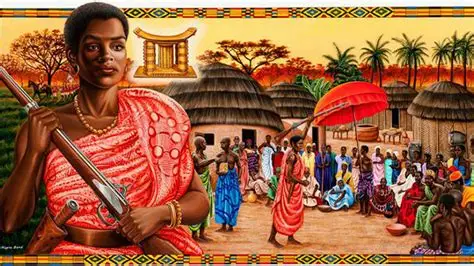
Nana Yaa Asantewaa was the Queen Mother of Ejisu in the Ashanti Empire, now part of modern-day Ghana. She led her people in a determined resistance against British colonial forces in 1900 during the War of the Golden Stool, also known as the Yaa Asantewaa War. Her actions made her one of the most prominent female leaders in African history and a symbol of courage and defense of cultural heritage.
Born into a farming family in the Ashanti region, Yaa Asantewaa rose through traditional roles to become a key political and military figure. She rallied warriors when male leaders hesitated, commanded forces, and protected the sacred Golden Stool, which embodied Ashanti unity and sovereignty. Her leadership in the face of colonial pressure continues to inspire generations in Ghana and beyond.
Yaa Asantewaa Early Life
Yaa Asantewaa was born around 1840 in Besease, a town in the Ejisu (Edweso) state of the Ashanti Empire. Her parents were Kwaku Ampoma and Ata Po, both farmers from the Asona clan. She grew up with one sibling, her brother Afrane Panin (also known as Nana Akwasi Afrane Okpese), who later became the chief of Ejisu.
Life in Besease and the surrounding areas revolved around agriculture and community traditions. As a young girl, Yaa Asantewaa helped on the family farms. She later moved to the area around Boankra, where she cultivated crops successfully. She specialized in vegetables, groundnuts, and onions, gaining respect as a hardworking and capable farmer. This period built her practical skills in resource management and community leadership, qualities that served her well later.
The Ashanti society into which she was born was matrilineal. Inheritance and authority passed through the mother’s line. Women held significant influence, especially in royal and clan matters. Yaa Asantewaa absorbed the history, customs, and values of her people from senior women in the community. She learned about the Golden Stool and the importance of unity under leaders like Osei Tutu, the founder of the Ashanti Empire.
Her childhood coincided with a time of expansion and occasional conflict for the Ashanti. The empire controlled rich gold resources and trade routes, which brought both prosperity and attention from European powers. Yaa Asantewaa witnessed the strength of Ashanti military organization and diplomatic traditions. These early experiences shaped her deep commitment to her people’s independence and cultural identity.
She entered a polygamous marriage with a man from Kumasi, with whom she had a daughter, Nana Ama Serwaa of Boankra. Some accounts mention a son or grandson involved in leadership. Her family ties connected her closely to the ruling structures of Ejisu and the broader Ashanti Confederacy.
The Ashanti Empire and Cultural Context
To understand Yaa Asantewaa, one must know the Ashanti Empire. It emerged in the late 17th century under Osei Tutu and the priest Okomfo Anokye. They unified Akan states into a powerful confederacy centered in Kumasi. The Golden Stool, said to have descended from the sky, symbolized the soul of the nation. No one sat on it; it represented the collective spirit of past, present, and future generations.
The empire developed a sophisticated government with the Asantehene as king, supported by a council of chiefs and queen mothers. It had a strong army, efficient bureaucracy, and control over gold and kola nut trade. Matrilineal succession gave queen mothers like Yaa Asantewaa substantial advisory and judicial roles. They nominated candidates for stools (positions of authority) and guarded lineage and traditions.
By the 19th century, the Ashanti faced increasing pressure from British traders and colonial ambitions on the Gold Coast. Earlier Anglo-Ashanti wars (in 1823–1831, 1863–1864, and 1873–1874) tested the empire’s resilience. The British sought control over trade and territory, while the Ashanti defended their sovereignty. These conflicts created a backdrop of tension and national pride that Yaa Asantewaa later drew upon.
Ejisu, located about 10 miles east of Kumasi, was an important component state. As queen mother there, Yaa Asantewaa held local authority while participating in wider confederacy decisions. Her position required wisdom, diplomacy, and the ability to mobilize people during crises.
Yaa Asantewaa Role as Queen Mother
Yaa Asantewaa became queen mother of Ejisu in the 1880s, likely after her brother’s death around 1894. She used her position to nominate her grandson as chief. When the British exiled Prempeh I (Asantehene) and other leaders including her relative in 1896, she became a regent figure and voiced strong opposition to colonial interference.
As queen mother, she advised on governance, succession, and justice. She managed land and resources tied to the stool. Her experience as a farmer helped her understand the economic needs of her people. She earned respect for her intelligence and determination even before the 1900 events.
The exile of Prempeh I created deep resentment. The British aimed to weaken Ashanti unity by removing key figures. Yaa Asantewaa saw this as an attack on the nation’s soul. She could not accept the loss of sovereignty and the desecration of sacred symbols. Her leadership filled the vacuum left by exiled rulers.
The Golden Stool and Its Significance
The Golden Stool stood at the heart of Ashanti identity. It was not a throne but a sacred object containing the spirit of the people. British Governor Sir Frederick Mitchell Hodgson demanded it in 1900 as a symbol of submission. This demand provoked outrage and unified resistance.
Yaa Asantewaa, as a guardian of traditions, viewed the demand as intolerable. She argued that surrendering the stool would mean the end of Ashanti independence. Her stance transformed a political dispute into a defense of cultural and spiritual existence. The stool remained hidden and protected throughout the conflict, representing a key victory for the Ashanti.
Yaa Asantewaa Leadership in the War of the Golden Stool
In March 1900, at a secret meeting of chiefs in Kumasi, hesitation prevailed. Yaa Asantewaa stood and delivered a powerful speech. She reminded the men of past Ashanti bravery under leaders like Osei Tutu and challenged them: if they would not fight, the women would. She reportedly fired a gun to emphasize her resolve.
The chiefs appointed her war leader, making her the first woman in Ashanti history to command a national army. She mobilized around 5,000 fighters. The war began with attacks on British positions. Ashanti forces besieged the fort in Kumasi, trapping Governor Hodgson and his party for weeks. They used guerrilla tactics, stockades, and knowledge of the terrain effectively.
The conflict, lasting several months, inflicted significant casualties on both sides. British reinforcements eventually arrived under Colonel James Willcocks. Despite brave resistance, superior British weaponry and numbers turned the tide. Yaa Asantewaa and her advisers continued fighting before her capture.
The war ended British hopes of easy control and highlighted Ashanti determination. It was the last major Anglo-Ashanti conflict. The Ashanti protected the Golden Stool, preserving a vital part of their heritage even as formal annexation followed in 1902.
Yaa Asantewaa Capture, Exile, and Later Years
After the rebellion, Yaa Asantewaa became a wanted person. She evaded capture for a time but was eventually taken along with about 15 advisers. In 1901, the British exiled her to the Seychelles Islands in the Indian Ocean, far from home.
In exile, she lived among other Ashanti leaders. Conditions were difficult, but she maintained her dignity. Some accounts say she converted to Christianity during this period. She died on October 17, 1921, at around age 80–81. Her remains were later repatriated after Prempeh I’s return in 1924 for a proper burial.
Yaa Asantewaa Achievements and Military Strategy
Yaa Asantewaa’s primary achievement was leading the 1900 resistance. She demonstrated exceptional organizational skills by coordinating warriors across regions. Her strategy included blocking roads, using ambushes, and sustaining a prolonged siege. These tactics delayed British victory and raised the cost of colonial expansion.
She challenged gender norms by taking military command. This inspired women and future generations to see leadership as open to all capable individuals. Her actions preserved Ashanti pride and contributed to the spirit of nationalism that later fueled Ghana’s independence in 1957.
Yaa Asantewaa Legacy
Yaa Asantewaa’s legacy lives on as a symbol of anti-colonial resistance and female empowerment. Schools, awards, and cultural events bear her name. The Yaa Asantewaa Girls’ Senior High School in Kumasi educates young women in her spirit of strength.
Museums and memorials, such as the one in Ejisu (though damaged by fire in 2004), honor her. Festivals in 2000 and 2006 commemorated the centenary. A Yaa Asantewaa Art Prize supports Ghanaian women artists, linking creativity to her courage.
Her story appears in literature, art, and education across Ghana and the African diaspora. She represents resilience against injustice and the defense of cultural identity. Modern Ghanaian women leaders often cite her as an inspiration.
Yaa Asantewaa Personal Life
Details of Yaa Asantewaa’s personal life focus on her roles as farmer, mother, and wife. She raised her daughter and maintained family connections to leadership. Her polygamous marriage fit Ashanti customs. She balanced domestic responsibilities with growing public influence.
In exile, separation from family brought sorrow, especially regarding her grandson. She endured hardship with the same resolve shown in war. Her life exemplified dedication to community over personal comfort.
Awards and Honors
While Yaa Asantewaa received no formal awards during her lifetime, posthumous honors abound. The Yaa Asantewaa Art Prize recognizes women artists. Various women’s valor awards carry her name. Schools and institutions celebrate her annually. Her inclusion in historical records and museums serves as enduring recognition.
Read Also: Ebiere Soberekon Biography: Age, State of Origin, Husband, Wedding Day, Career, Net Worth & Family
Conclusion
Nana Yaa Asantewaa stands as a towering figure in Ghanaian and African history. From her roots as a farmer in Besease to her command in battle, she dedicated herself to protecting her people’s freedom and heritage. Her leadership in the War of the Golden Stool delayed colonial domination and preserved the Ashanti spirit. Today, her example encourages unity, courage, and cultural pride. Her life reminds us that determination can challenge even powerful empires and that women have always played vital roles in the defense of nations.
FAQs
Who was Nana Yaa Asantewaa?
Nana Yaa Asantewaa was the Queen Mother of Ejisu in the Ashanti Empire who led the 1900 resistance against the British.
When and where was Yaa Asantewaa born?
She was born around 1840 in Besease, in the Ejisu area of what is now Ghana.
What is the War of the Golden Stool?
It was the 1900 conflict where Ashanti forces under Yaa Asantewaa fought to protect the sacred Golden Stool and resist British control.
Why did Yaa Asantewaa fight the British?
She fought to defend Ashanti sovereignty, the Golden Stool, and the return of exiled leaders like Prempeh I.
Where did Yaa Asantewaa die?
She died in exile in the Seychelles on October 17, 1921.
What is Yaa Asantewaa’s legacy today?
She inspires education, art prizes, museums, and discussions on leadership and women’s roles in African history.
Did Yaa Asantewaa have children?
Yes, she had a daughter, Nana Ama Serwaa, and family ties to Ashanti leadership.
How did the Ashanti Empire respond to colonialism?
Through a series of wars and, under Yaa Asantewaa, a major uprising in 1900 that preserved key symbols of identity.